Monday, August 23, 2021

Pedantic Wasteland - A Rasp of Sand


A Rasp of Sand (“AROS”) is an adventure written, laid out and illustrated by Dave Cox and was funded as part of the original “ZineQuest” for Kickstarter. At 75 pages, AROS pushes against the definition of “zine” and may be more appropriately dubbed a “book.” AROS is written at times with all OSR systems in mind, but it is so thoroughly integrated into Knave by Ben Milton (of Questing Beast fame) that it is more accurate to label AROS as an adventure for Knave, that could be run for non-Knave systems with some referee-applied elbow grease. AROS is a procedural dungeon crawl that is unique in its oceanic theming. But what really sets AROS apart is its ambitious goal: AROS explicitly draws from the rogue-lite subgenre of video games. AROS succeeds with flying colors in this endeavor, producing a cohesive adventure in the rogue-lite vein that encourages player mastery in a way that is unique from a typical dungeon crawl.


Disclosure: This review is not based on my experience playing in or running AROS. Instead, my conclusions are reached based on a thorough reading of AROS. However, I did also consult with @qpop in writing this review, who has run the adventure to completion twice for a group of 4-6 players over four generations (of player-characters, not of players—more on that later) and just ran a speedrun of the adventure with some of the same players! You can see a rundown of the speedrun in this tweet thread.

What is a Rogue-lite?

To understand why AROS makes the decisions it does, it is important to understand the rogue-lite video game subgenre. To answer what a rogue-lite video game is, you must first unravel what a roguelike video game is. The simplest definition is that it is any video game that is like Rogue, a 1980 ASCII-based video game inspired by Dungeons & Dragons. But truly unraveling the meaning of roguelike or rogue-lite would be a poor use of your time on a TTRPG review site. (Although, Anne of DIY & Dragons [and of here!] put together an interesting list of roguelike advice as it relates to and is helpful for tabletop gaming. It is worth checking out if you are interested in exploring this intersection further.) “Roguelike” is a hotly contested term. There is a “Berlin Interpretation” that sets out a number of factors, but such interpretation is far from being widely accepted. To skip past the quasi-medieval scholasticism surrounding these key terms, the two most important aspects of a roguelike are permadeath—when the character dies, they start the game over in a new “run”—and procedural dungeon generation. Rogue-lites shed the strictures of the Berlin Interpretation and embrace metaplay, allowing players to unlock persistent features that carry over to future runs. The rogue-lite to which AROS shares the most DNA is Rogue Legacy, a 2013 rogue-lite. The similarities between AROS and Rogue Legacy are mechanical and fictional and hinge on the idea of “heirs.” When you die in Rogue Legacy, you pick between three randomly generated heirs, which have chances to inherit characteristics from your now-deceased character. AROS handles it somewhat differently, but the idea is the same.

Heirs & Heritage

In AROS, you do not play a character; you play a family. Each run through the dungeon is performed by a generation of characters, called Heirs. This is the fictional justification for the progression between runs. Because characters are actually expected to die and allow the next crop of Heirs to take a run at the dungeon, AROS produces a truly deadly experience, unlike other games where the characters are simply too precious to die. The most important thing each Heir passes down to their successor is their memories of the dungeon, but this aspect merits its own section (see Memory, Metagaming & Mastery below). Heirs also inherit ⅙ of their predecessor’s XP, one heirloom and any mutations from their predecessors. [Practical note: according to qpop, the XP passed down was fairly insignificant, but the passing down of heirlooms was a driver of strategy, causing players to debate over who should carry what items, which ideally should be spread out across the party in case of wipeouts.] Mutations are special abilities that Heirs may gain when they consume the vital essence (or “Sand”) left behind by different monsters. AROS also uses a process tailormade to Knave for determining a new Heir’s ability defense and ability bonus based on the previous Heir’s ability defenses. Each family has a family trade, and Heirs gain special abilities related to these trades. It functions like a traditional class system (which Knave does not have), but new abilities are gained by new generations instead of by leveling up. 


The family trade is interesting in that it provides a link between the families and their island community, but it is less effective at passing forward progress from one run to the next. For each of the other aspects passed down, the benefit varies based on what the predecessor did—how much experience they earned, what items they gained, which abilities they increased and which mutations they gained. By contrast, each new generation in the same trade gains the next ability on the list for the trade. It does not matter how successful the previous Heir was or how they used the abilities from their trade, a new Heir advances just by virtue of being the next generation. One of Knave’s strengths is its simplicity, and this reduces the simplicity of Knave without adding much to the feeling of progression. If I were to run this adventure, I would probably ignore the trade abilities, although I would still have players roll for the trade that their family performs and start with the equipment listed for such trade. However, qpop disagrees and said that, in his experience with the adventure, the trade abilities provided a nice sense of progression and a through-line for the Heirs from generation to generation. Some of the abilities, like the Academic’s fourth-generation ability to siphon XP from treasure were game-changing (it seems that the fourth generation ability for each trade is quite an increase in power for the Heirs, in general). My main quibble is perhaps that acquiring the next generation’s ability is too automatic. Imagine a generation of Heirs that dies in the first room (which apparently did happen in one instance for qpop and his players—a reminder that this is a deadly adventure). In such an instance, the next set of Heirs would get a new ability despite the unequivocal failure of their forebears. I prefer progression to reward some type of success; if it is automatic, it feels unearned, which I don’t love when I am player-side.


Permadeath, Procedural Generation & Repetition

For AROS to include permadeath, that core aspect of a roguelike (or rogue-lite), it has to function differently than it would in a single-player video game experience. Dungeons & Dragons and its descendants all feature permadeath in a certain sense—when a character dies, the player must make a new character (absent a method of revival, such as magic). However, this new character typically joins the existing party, slotting into the campaign where the dearly departed character left off. Even if the players experience a total party kill (“TPK”), there is typically no rewinding of the clock, starting the adventure over again from the beginning. Just as strict time records are kept, time inevitably marches forward.


When a Heir dies in AROS’ dungeon, the Deep Queen’s Temple, the dungeon will flood, forcing all surviving characters to evacuate or die. Upon returning to their island home, a generation of time passes before the next set of Heirs will enter the Deep Queen’s Temple. This means that any character death acts as a TPK. But it is the fiction of AROS that causes this to resemble permadeath from a roguelike. Namely, the adventure hook. Essentially, the Heirs are the descendants of people that stole the crown of the mightiest of all spirits, the Deep Queen, and created a lake, which drowned the Deep Queen’s son, the Green Prince. As punishment, the Deep Queen flooded the world. The people now live on the few islands that were once mountaintops. Once in a generation, you have a chance to enter the Deep Queen’s Temple, return the crown and set the world right again. This is not just lore; it’s lore with a purpose. This adventure is not designed for sandbox or self-directed play. Players will be myopically focused on getting to the end of the Deep Queen’s Temple, which will necessitate multiple delves from multiple generations of heroes.


Most adventures are single-use. Or to the extent they aren’t, they still aren’t intended to run for the same players over and over. White Plume Mountain is still fun to play through a second time, but much is lost when you know what is coming next. The Deep Queen’s Temple, on the other hand, is built for replayability (as is AROS itself). It accomplishes this the same way its roguelike predecessors do: procedurally generated dungeons.


A procedurally generated dungeon is not the same as a randomly generated dungeon. A randomly generated dungeon would be stitching together random parts, without rhyme or reason beyond probabilities. If you use the generators in the back of the AD&D Dungeon Master’s Guide, that is close to random generation. If a dungeon level were generated entirely randomly during each run, what the players learn would have no bearing on future runs. Procedural generation acts as a set of instructions to guide the randomness toward certain types of results. It is randomness with its own set of logic. Going through a procedurally generated dungeon allows players to learn about how the dungeon works, which may be useful in future runs. This stands in contrast to a classic dungeon crawl where the layout and rooms do not change. There, players learn much more about the dungeon. But each repeated delve is a less fresh experience. Procedurally generated dungeons are designed to encourage repeated delves by rewarding dungeon mastery (by the players, not the proverbial dungeon-master) while offering a new experience each time.


To produce a dungeon for players to navigate, the referee must navigate the dungeon generation procedures in AROS. The Deep Queen’s Temple has five levels, each reflecting a deeper level of the ocean: Pelagic, Reef, Kelp Forest, Twilight and the Trench. For each run, each level requires that the players must explore [3d10, keep the highest] rooms before the exit appears to them. For each room, the referee rolls for a location and a situation. There is a d20 table for situations (with 14 results), and each level of the dungeon has a d12 table for locations. That’s 168 possible combinations for each level. While players are likely to encounter the same rooms across different runs, the situation is likely to differ. To pick a slight nit, I would have preferred for level-specific situation tables, both to add variety between the levels and also to minimize flipping pages when rolling up rooms on the fly. At first glance, I greatly disliked the rule about players needing to explore a minimum number of rooms and then the exit will “show up.” But at the back of AROS, there is an example of mapping a dungeon level that suggests the level should be mapped out ahead of time, which mitigated my concerns about it. However, some trade abilities, like the Sailor’s fourth generation ability (it’s always the fourth) allow the players to influence the dungeon generation, suggesting that the dungeon is generated on the fly. Per the example in the back, AROS doesn’t require a grind through a certain amount of rooms. Instead, there is some looping, and the exit can be reached without going through every room. My advice to anyone running this is simply to use Shifting Sands, a fan-made tool that is a very impressive distillation of AROS, including Heir generation and dungeon generation. Shifting Sands is a truly excellent resource. While AROS is completely functional without it, this is a tool that would truly make it a breeze for the referee. 

Against Goblins

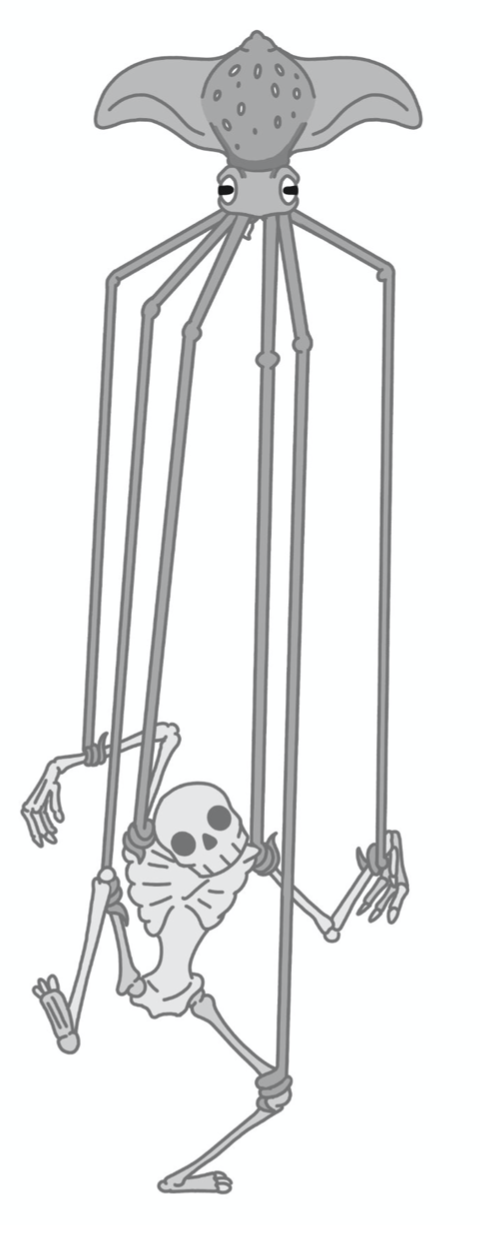
AROS eschews goblins, dragons and all the familiar beasties of bog-standard fantasy RPGs. In their place, AROS offers 42 new monsters to find in the Deep Queen’s Temple (the section, entitled “Creatures of the Deep” is curiously omitted from the table of contents, but this is just another nit). The monsters are statted for Knave but could be converted with a modicum of effort. Almost every monster also has one of the aforementioned Mutations. So if a character eats the Sand of a Dolpod (a dolphinesque humanoid), you have a 25% chance that your forehead expands to make room for resonating space you need in your sinuses and you gain the power of echolocation when you make loud clicking noises. My favorite mutations are of this variety, where the power is telegraphed by physical changes in the Heir. Gaining enough mutations may also impact what happens the Deep Queen is encountered (though for exactly how, you will need to play in or read the adventure for yourself!). There are plenty of excellent monsters listed in AROS to populate the repeated dungeon runs. One of my favorites is the Marionetta Squid, which has a gimmick that the picture alone easily communicates.

Using all new monsters is purposeful for the design of AROS. The monsters not only mesh with the adventure aesthetically—the monsters share an aquatic theme, and not in the lazy way of many D&D aquatic monsters (I have in mind Lacedons and Koalinths)—but also are integral to make repeated excursions into the dungeon a meaningful and engaging experience. When you fight a goblin in D&D, you probably already know what you are getting into. Even if goblins are new to your character, you as a player know their essential characteristics. But how much do you know about a chum? Could you, for instance, distinguish a balloon chum from a tropical chum? Unless you are a veteran of AROS, I suspect the answer is a definitive “no.” In AROS, the Heirs and the players themselves each learn more and more about the ecology of the Deep Queen’s Temple with each run. Because of the “Sand” in AROS, players are encouraged to metagame with this knowledge, as it represents something subsequent Heirs learn from their forebears.

Memory, Metagaming & Mastery

In AROS, when any creature, including a Heir, dies, they leave behind grains of sand, appropriately called “Sand.” When a Heir ingests the Sand, they gain some XP and the memories of that creature. This is how Heirs pass down memories from generation to generation. As AROS explains, “There aren’t any actual rules for this, at least not in the traditional sense. Essentially you can metagame with knowledge from previous runs.” I’m glad that AROS uses the term metagaming if only to allow me to talk about it briefly. 


Metagaming is bandied about as a pejorative term and it is unduly maligned in roleplaying games. Metagaming is an acknowledgement that there is a disconnect between the knowledge of the player and the knowledge of their character as well as a taboo against using exclusively player-knowledge in games. An example in the above-linked Papers & Pencils blog post is the player knowing the effect of fires on trolls while the character has not experienced a troll. The taboo arises in more thespian-oriented games and is verboten because it is an example of breaking character. In the Wikipedia article on the subject, it says that metagaming is “considered unsporting or cheating”, although this claim is both in passive voice (considered by whom?) and followed by a [citation needed]. 


While I agree with my colleague, Nick LS Whelan, on having no qualms with metagaming, AROS is intentionally designed to (1) encourage metagaming-like behavior and (2) justify metagaming such that player knowledge IS character knowledge, for the most part. Because there are no goblins or other recognizable trappings of fantasy RPGs, players and their Heirs start their first run through the dungeon with the same minimal set of knowledge. What is learned about the dungeon, from its contents to its denizens, is passed down from Heir to Heir. There is little that the player knows that their current Heir shouldn’t know equally well. However, while this is not metagaming from a definitional standpoint, it facilitates player-challenge-based play, which is a strength of metagaming. In TTRPGs, typically both the character and the player are being challenged in different ways. While the character may become better equipped to face their challenges through level-ups, finding items or other in-game processes of advancement, the player only has one avenue for advancement: becoming a better player. Mastery of the system, mastery of their character, mastery of the game, all of these improve over time. With repeated runs of the same (or similar, being generated by the same procedure) dungeon, the player gains knowledge that helps them improve at facing the challenges therein. Even outside of AROS, this is fun for some players and groups. What AROS does, and it is a great strength of the adventure, is that it bakes this type of player-challenge-based play into the adventure fictionally. It truly is not metagaming to use the player-knowledge from previous runs in a current or future run through the Deep Queen’s Temple because your Heir has the same knowledge, passed down from the Sand. This fictional conceit is a permission structure for players to embrace player-challenge and dungeon-mastery (of a different sort than is typically meant by “dungeon master”), free from any character-breaking that is considered (presumably, by someone) cheating. In AROS, it would be unsporting to not metagame (and, given AROS’ deadliness, self-sabotaging).


Press F for Action Prompts

While AROS ingeniously integrates its video game inspirations into TTRPG form when it comes to roguelites, there are small portions that feel video-gamey in a less-than-stellar way. This is not a problem unique to AROS; I’ve come across it so often that I have given it a name: the Action Prompt Problem. Action prompts are moments in those quick time events commonly used in video games. They allow a scintilla of player input during largely cinematic sequences, for instance, allowing the player to pay respects during a cutscene of a funeral by pressing a button. In TTRPGs, this impulse manifests itself in referee-facing cues that trigger based on player action that the player is unlikely to actually perform unprompted. Secret information is good, but players should have some reasonable inkling that the secret information is there or a reason to interact with the world in a way that might reveal it. I will go over one example of the Action Prompt Problem in action in AROS, along with a simple “fix” for it. Hopefully this example better illustrates what this problem is, why it is a problem and how to avoid it in writing site-based adventures. 


The weeping statue. In one of the rooms of the Kelp Forest, there is an alcove with a statue of a weeping man, among other things. The referee-facing room description says “If the Heirs wash their face in the tears of the male statue, they can see a path across the abyss [the major feature of the room]. It twists and undulates but provides solid footing.” My issue is simply why would the players wash their face? Investigate the crying statue, sure, but nothing about the statue or the room indicates that this is the time for a skincare routine. Contrast this with the other statue in the room, which the read-aloud text describes as “a statue of a woman holding a small bundle wrapped in seaweed up to her chest. She similarly has water running down her face, but it pools onto the floor and runs into the abyss.” This statue has hidden information (as opposed to secret information; for a taxonomy, check out this excellent post from DIY & Dragons), but it is gleaned simply by “investigating the bundle in the arms of the female statue,” an action thoughtful players are already likely to take. My fix to the face washing prompt is simple: get the players dirty. Either through an ink cloud of one of the creatures that emits it, or have another enemy fling mud at them. When the dirty PCs come to the room with the statues, they do not have a reason to know that either statue has magic face-washing properties, but they at least have a potential reason to want to wash their face. Another solution is just to tell the players, if they so inquire, that the water coming from the male statue looks different than the water from the female statue. But I like the dirty face idea more. Sometimes it is fun when players push a big red button by dumb luck.


Adventure Coherence

Despite a few pedantic nit picks (solely in an attempt to live up to my series’ name, I assure you), AROS is an unusually coherent adventure. That is not to say that other adventures are incoherent in the sense that they are incomprehensible; I mean to say that AROS coheres together to form a unified whole, while I approach other adventurers like a car mechanic in a junkyard, looking for parts to rip out and insert into whatever I’m currently building. I am not sure that there are any specific, discrete parts of AROS I would steal, because each part is so codependent on the rest. AROS is the rare sort of adventure that I would not only consider running, but that I would consider running by the book. Rarer still, AROS’ roguelite elements and its full embrace of the positives of metagaming result in it being an adventure that benefits from repeated games, even with the same group. TL;DR: I recommend AROS to any dungeon-master whose players would enjoy experiencing their own, distinct form of dungeon-mastery.

Where to Find A Rasp of Sand

A Rasp of Sand was written by Dave Cox. It can be obtained in PDF for $10 on itch.io or in softcover for $18 on DriveThruRPG. 


Tuesday, August 17, 2021

Brain Infestations - The Waking of Willowby Hall


The Waking of Willowby Hall is an adventure by Ben Milton (aka Questing Beast) produced as part of Zinequest 2, with illustration from Sam Mameli (aka Skullboy) and edited and published by Jacob Hurst of Swordfish Islands. It’s designed to be used with any old-school system, but assumes a B/Xish base with 3rd level characters.

I ran this game as a one-shot live on stream with a group of 4 players, most of whom were relatively new to old-school style play. We ran it using my system, Errant, with 1st level characters (they were all first-time players of the system also). You can watch the session here.

The short version of this review is that this adventure is, as is likely well known by this point, absolutely excellent. It is a masterclass in usable design, and the flaws I find within are only minor nitpicks at best. The scenario provided within is dynamic and inventive, and the aesthetics of the product are absolutely dynamite and point towards, I think, a new sort of poetics for the old-school space moving forward.

USABILITY

This is probably my foremost concern when looking at any adventure, above and beyond the content. I am pretty confident in my ability to take even the blandest dungeons and ensure that it results in a pretty fun time at the table (though this is largely due to my common habit of integrating them into ongoing campaigns, which by their very nature add depth, complexity and interest; for one-shots, the content of the adventure needs to pack a little more punch). However, I’m not really great at coming up with completely off-the-cuff original scenarios (probably an atrophied skill due to how much I rely on published adventures), so really what I look for is just something I can pick up and parse with little effort to throw my players into. “Parse with little effort” is an incredibly load-bearing phrase here, because I am notoriously bad at reading maps and imagining architectural spaces, so I really need straightforward cartography and clear room-keying so as to not overtax my last two remaining brain cells.

I am happy then to report that Willowby Hall rates exceptionally well in this regard.

Maps

The map is rendered with clear, bold lines; the layout of the dungeon is a fairly straightforward manor, where each room enters into another one, without any hallways in between; each room is not numerically keyed in the normal fashion, but rather labelled with the page number where the room description can be found. There are also basically no symbols that require a legend: there’s doors, secret doors, stairs, and windows, all immediately intuitively legible at first glance.

The maps are presented in full size on the first 3 spreads of the book, utilizing the inner front cover for space, along with quick reference notes for the contents of each room. These maps are then replicated in a smaller size in the interior of the book with the room descriptions, with each spread having a map of the floor of the manor being detailed with the specific rooms highlighted. This is probably my favourite thing I can see in an adventure; it reduces page flipping immensely and helps keep the DM oriented to the player’s position relative to the layout of the space at all time. Funnily enough though, I find that this basically obviates the need for those first 3 full spread maps, except as an initial overview to familiarize oneself with the space in its entirety. The brief room notes on this map, clearly intended as quick reference during play, basically are obsoleted since I found no need to ever have anything but the spread of the rooms the player’s were in open at any given time.

The module also comes with maps ready for VTT play, which made the game incredibly easy to run. Honestly at this point I feel this should basically come standard with all adventures.

VTT Maps

Two minor quibbles with the maps. First, the VTT maps, which are playing facing, still have the secret doors on them marked. An easy fix, but also kind of a silly oversight. Second, the doors on all the maps are shown as open. I assume this was to indicate the direction doors open in, which can be relevant especially if considering how to hide behind them (a concern likely to come up in this adventure), and also I took it to mean that all the doors in the manor were unlocked, but there isn’t much indication of this anywhere in the descriptive text. A little note on that, and the inclusion of some stuck or locked door, I think would have been a welcome addition to the adventure: trying to pick the lock before the giant peers into the room, or having to bash a door down to progress, creating sound that draws the attention of Bonebreaker Tom, have the potential to be exciting and memorable moments. Pay attention to doors in your dungeon crawls!

Room Keying

The room descriptions utilize a minimal keying structure with bolded key words and tiered descriptions based on information level, similar to that found in OSE products. In each room are several sentences describing the salient features of the room which are immediately apparent; beneath each of these structures are indented bullet points with further information about each feature that are notable with further inspection. For example, the first room, the Great Hall, has at the sentence level “a wrought iron chandelier”. Below that are two indented bullet points describing what the players would see if they took a closer look at the chandelier: one socket has a black candle in it, and there are cracks in the ceiling where the chandelier is attached. Indented below that last point is a note that swinging on the chandelier has a 50% chance of causing it to crash to the ground. Information is tiered by salience, essentially following an “immediately apparent -> close look -> closer look” structure. This makes describing rooms a breeze, an almost programmatic “if-then” sequence for the DM to follow: when the player’s enter a room, describe all the stuff at the sentence level, and as they investigate features, just move down the levels of indentation. Writing is minimal without coming across as terse, with plenty of evocative description.

Layout & Other Matters of Note

The layout of the adventure is pretty consistently excellent, of the kind that’s executed so well as to seem unremarkable. As expected, pages are organized into neat, two-page spreads with everything relevant to that section of the adventure contained within.

The two spreads devoted to most of the NPCs in the adventure were ones I particularly enjoyed; 2 characters per page, with a column of text describing their stats and motivations below, cumulatively resulting in a Usual Suspects-esque identity parade. This is something I’ve seen in other adventures as well, probably first in The Cursed Chateau, but since then it’s cropped up elsewhere like in Dead Planet, Willow, and Darkness Moves. The fairly uniform nature of the NPC portraits was also really helpful for running this game online as I could screenshot them into pretty easy player handouts to show what the characters look like, without any awkward cropping to hide game relevant info.


The only quibble I have here is that the last spread of the book is a little awkward, with one room spilling onto the inner back cover, resulting in about half of that page space being empty. With the inner front cover put to such great use with a map and simplified key of the first floor, it makes this wasted space more pronounced. I think it could have been better served by adding an extra sheet to the zine, and using the last spread with the inner back cover to replicate the adventure’s encounter tables, which are buried a little awkwardly in the 11th page, to reduce page flipping.

Besides layout, there a few minor quibbles I had when running the game that I think could have been elaborated or clarified better within the adventure. First is the question of how exactly Bonebreaker Tom should be ran. The adventure provides a mechanic whereby on a roll of 2 on the encounter die, the GM rolls a d12 and has Tom move in that direction around the manor and swings his bell at the wall. But to me it was unclear whether or not I was supposed to have Tom roaming around the manor in between rolls of 2 (e.g. rolls of 2 simply trigger a “move and swing” action from Tom rather than his usual “roam” protocol), or if once Tom had moved to a location he remained there until the next roll of 2. The adventure states that Tom peers into windows “as he moves”, but doesn’t really fully answer the question of his movement. The adventure places a pretty big emphasis on having to hide from Tom to keep the tension of the adventure up, which is reinforced both by aesthetics (the cover illustration of the NPC party hiding from Tom) and design (the numerous hiding places detailed in each room). When I ran the game, I opted for the latter approach (Tom is stationary in between rolls of 2), but this resulted in that aspect of the adventure not being really relevant past the initial segment; however, I could see a case where a constantly roaming Tom might make it too onerous to achieve much within the dungeon. Still, I think the first approach of having Tom periodically roam around the manor in between rolls of 2 would provide a more engaging gameplay experience.

Second, there are two little “miniquests” within the manor that involve the moving of fairly large and heavy objects from one area to another, but doesn’t provide much guidance for making rulings regarding weight and encumbrance of these objects (one a heavy free-standing mirror, the other a harpsichord). One could argue it would be easy to make a ruling in the moment based on intuition, but I’ll note that after researching to find the likely weights of these objects (50-75 lbs for the mirror, 100-125 lbs for the harpsichord) I would have vastly overestimated the weight of the harpsichord in play (in my head it was more the weight of a grand piano) and underestimated the weight of the mirror (I assumed one person could have carried it kind of awkwardly). Something like the mechanic for moving the granite slab covering the tomb entrance in Winter’s Daughter (“Moving the slab: Requires a cumulative STR bonus of at least 4”) would have sufficed (my personal ruling would be that the mirror/harpsichord require cumulative STR 20/40 to lift).

The miniquest involving the harpsichord also struck me as being a little odd. For one thing, it’s given by the ghost of Lavinia, trapped within the harpsichord itself. Whereas every other NPC is given a “want” that defines basic motivations that while inform their actions, Lavinia’s takes the form of this one-time task, which seems like it undersketches her character. Second, for how difficult the task is (moving a heavy harpsichord from one floor of the house to the upper floor while avoiding dungeon hazards and an angry giant), there’s no reward at all for doing so, unlike the miniquest involving the mirror which rewards one with important information. The only thing relevant to the harpsichord in the guest bedroom, the place Lavinia asks it to be moved to, is sheet music which when played on the harpsichord…summons the ghost of Lavinia, the one who gave you this quest in the first place. Yeah.

Finally, and this is almost entirely a personal preference of mine, I find the “triggered” nature of the adventure’s events would make it hard for me to incorporate this module into campaign play. My method for using modules is to just place them somewhere on my campaign map for my players to run into; if I attempted that approach here, that would mean that as soon as the players stumbled onto where this adventure was keyed, no matter when they did it, then that would be the exact day that the sequence of events regarding Tom and the NPC adventurers had played out. This might not bother most of you but something about that approach strikes me as off-puttingly videogame-ish. The alternative I suppose would be to not only assign the adventure a place on the map but also a date on the calendar, but unless there’s heavy forecasting to let the players know something goes down on that date, that also feels a little unsatisfying. Though you could always play it a bit forward and have the party hear rumours that a giant’s golden-egg laying goose was stolen and have them deal with that aftermath, but that is significant adaptational work on the part of the GM. Though, it must be said that these qualities which make the adventure difficult to integrate into a campaign make it an excellent one-shot adventure, all but guaranteeing that your game will hit the ground running, which is especially important if you’re playing at a convention or somewhere else with a limited time slot.

AESTHETICS

I’ll conclude this review with a brief discussion of the aesthetics of the adventure, which can really only be described as pretty as fuck. Seriously, this adventure is so gorgeously illustrated that when I got this in the mail my partner wanted to flip through the book simply just to look at them. The cover piece in particular is gorgeous, with an incredibly striking and vibrant blue and yellow palette (my partner also decided to base my make-up for the stream in which I ran this on the cover). Having the whole book be illustrated by one artist also presents a unified aesthetic which really gives the adventure a characteristic feel and tone. Sam Mameli really knocked it out of the park with this one.

An odd thing about the cover illustration being so striking that I’ve noticed happen a few times though is that people approaching this module think that the NPC adventurers which are depicted on the cover are actually the PCs, as they’re the point of identification within that drawing. This is a point of confusion that seems somewhat common when even the hook of the module is being discussed, where people assume that the PCs are the one who stole Mildred the goose. In play also, especially for a one-shot where the players don’t know each other and the PCs are new and a little half-formed, I think there is a bit of a risk of the NPC adventurers, who are so well drawn (in both the literal and figurative sense), overshadowing the players.

The reason I choose to discuss the aesthetic of the adventure though is not solely because of the quality of the art, which as excellent, but the way the aesthetic serves to heighten the usability of the adventure. It does this through conveyance; when I first saw the image of Bonebreaker Tom, his eyes scrunched shut, his huge mouth open screaming within the tangled mess of his beard, I could immediately hear his voice and mannerisms (which for me was pretty much just Brian Blessed).


Mildred is much the same way; her dead eyed stare immediately painted the picture of how I would run her, as a combination of the horrible goose from Untitled Goose Game but with the warm mischief swapped out for the soulless cruelty of Damien from The Omen.

This usability extends not just to the GM but to the players to. Everything in Willowby Hall has a sort of cartoon fairytale logic to it that will be immediately recognizable to players, like something out of Fantasia. This clues players onto the expectations of the adventure (once they see a giant with a goose, they’ll almost immediately grok what’s going on), and provides a framework for assumptions which is important when trying to navigate potentially deadly puzzles and traps, ultimately resulting in an incredibly toyetic experience. It manages to achieve the strengths of vanilla fantasy, the quick communication of fundamental assumptions about the setting and its logic, while still being a little off-centre enough from that aesthetic to be surprising (animated taxidermied owlbear probably sums this up the best).

I feel like this fairytale/folklore/cartoon aesthetic is one we’re seeing more and more in old school play, with settings like Dolmenwood (being more on the folklore side of things) as well as the illustrations of folks like Evlyn Moreau and Nate Treme. I think that, counterintuitive as it may seem, this is actually an aesthetic I think works really well with the old school play, particularly the high lethality aspect of it. Whereas previously creators have opted for grimdark and miserycrawls to set the expectations for high lethality play, I think this cartoon-ish style works just as well for that purpose with the added benefit of being far more appealing and accessible to a wide variety of folks. There’s something about the vibe of this adventure that to me feels halfway in between something like Adventure Time and Happy Tree Friends; lighthearted, but still with the possibility for violence and disturbing features. I can pretty vividly imagine, when I read Bonebreaker Tom’s bell flail attack (dealing 6d6 damage), of some hapless adventurer being crushed against the floor with a “SPLAT!” sound effect. I think this achieves the effect of creating a bit of an ironic detachment from one’s player character, so that one can relish in the humour of your cute little dude meeting some tragic demise. While I still love my gross-out, shit and blood dark fantasy settings too (which, to be clear, I also find funny though in a pretty different way) I am glad to see a diversity of different aesthetics proliferating in this space after a period of one particular aesthetic reigning rather hegemonically.

CONCLUSION

This was a lot of words about an adventure that is honestly pretty much near-flawless. In summary, go play this one. Not only is it eminently runnable, it also is really unique in terms of play experience from most other modules out there; usually I’ve found that an adventure either pulls off the former or the latter. This is the rare one that pulls off both.

Wednesday, August 11, 2021

Grave Trespass - Gradient Descent


Is Luke Gearing too powerful? Certainly. Luke’s latest work for Tuesday Knight Games is Gradient Descent, a megadungeon written for the sci-fi horror game Mothership. The braintrust at Mothership HQ asks the question, “can you fit a megadungeon in a small zine?” Yes, apparently you can.

I may have been the first person to run the module who didn’t help play test. It has a compelling premise: a giant space station, an evil AI, Bladerunner nonsense, etc: all the good stuff. I read it and was enthralled. Brendan and Evan played a game I ran online, starting in media res, trying to flee the space station with an artifact they found “off camera”. It was a fun game. Months later I picked the module up again and started a longer campaign, which has been running for several months now. As it winds down I have lots of thoughts about this adventure.

Gradient Descent is a 64 page full colour zine: it’s a very dense 64 pages. Like all good OSR books it opens suggesting how you might use this adventure, from the basis of a campaign to something to simply hoover up ideas from. Luke explains some basic procedures of play and how the module works and then we jump right into things. There is an AI, Monarch, that controls a massive space station called The Deep. This is a huge factory complex, abandoned by its corporate overlords. Next we learn about what orbits the Deep. My Mothership campaign had the players begin in The Bell, a small retrofitted thruster that serves as a safe haven for people exploring the station. There they met a small coterie of NPCs who can help kick things off. As part of a larger campaign I would have had them try and cross a blockade to reach the station, and perhaps make friends with Commander Kilroy, another NPC with goals they might help achieve. Along with some “monsters”, these are the things outlined first. Then we move onto the “dungeon” itself, which makes up the bulk of the adventure. The Deep is huge. There are several floors, many sections, and a web of interconnections. It’s a complex and interesting dungeon. In a twisted way you can almost picture what the factory would have been like in the past. Finally the book concludes with a table of random artifacts, some super science. The back cover of the module is an "I search the body" table.

The art by Nick Tofani is wonderfully moody, often creepy. A perfect fit for this module. I would share it with my players often. Jarret Crader, the man behind all your favorite RPG books, did development editing. With a module such as this, I suspect no easy feat. Finally, Sean McCoy did the layout, and it’s a real chef kiss emoji.

The book continues a long tradition of really strong graphic and information design that feels like the most standout feature of the Mothership line. I see a lot of the design cues from one page dungeons at play here. The adventure is laid out with the two page spreads of the zine in mind. You can likely run each section of the dungeon with minimal page flipping. When I was running the adventure, from a PDF, I would normally only need to jump to the sections about the androids, ghosts in the machine, or monarch. If I had the zine in my hands I’d put some post it notes there and that would be that. (I am weirdly cheap about shipping, so my copy of this zine had been sitting with my brother in NYC for the last year and change. Of course, it arrived in Toronto just as I wrapped up running things.) There is so much information this book is trying to get across, and it does a remarkable job at doing just that.

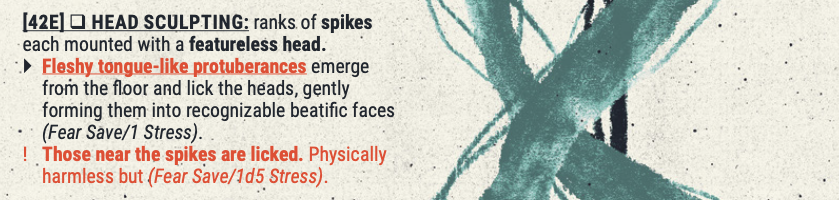
The descriptions in this dungeon are terse. On the whole I think this is a positive, and is what allowed me to run my games straight out of the book. It takes you seconds to read what’s going on in any room the players have walked into. For example:

The square in the title indicates this is a large industrial scale space: you should imagine a large factory or warehouse. In my head when I read this I pictured something akin to rows of corn. To avoid being licked would take some dexterity or creativity. The scene is both horrific and cold: there heads on stakes, but everything is artificial.

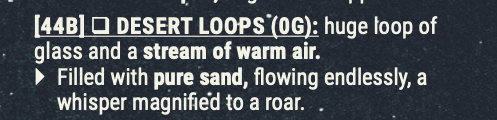
What now? Again this is a huge room, but I found it harder to imagine what its deal might be, where the loop of glass was going, and what it might be for. I know you might use sand for cleaning or scouring in a factory, perhaps for making glass, but I couldn’t quite picture what Luke wanted me to take away from this scene. I do like the phrase, "a whisper magnified to a roar," though. In a space where you maybe expect to hear the clanking and crashing of a factory, this suggests a different sort of noisy space.

Most of the time there is enough for you to improvise on top of, especially for you pro-star GMs. I'm not sure i'm quite there, so I found myself describing rooms as “large industrial spaces” a lot, or falling back on analogies of Toyota factories. I should have watched some old films and made some dungeon dressing tables. I think if there was more space that would be a nice addition to the book: examples of what these alien industrial spaces might look like. A small table of ideas might be all it takes to help cement a space in your head. I would not want to see the descriptions of the rooms themselves expanded: improvising poorly is better than discovering well into play you forgot something important buried deep in some multi paragraph description of a space. I suppose the module is really trying to get straight to the point with everything it presents. We don't have pages and pages of backstory about The Deep. If you read the module you'll have a good sense of what's up, with enough space for you to inject what you want. The module is flavourful: it paints a real picture of this strange alien space, certainly at the macro level.

Gradient Descent declares itself a sprawling sci-fi megadungeon. “But Ram, what does that even mean?” I would have shrugged my shoulders, but thankfully many years ago Gus wrote a blog post musing about what makes a megadungeon both mega and good. I regret not re-reading this blog post before running my games because I think it would have informed my GMing and improved the campaign.

The Deep is split up into 11 discrete interconnected sections. This doesn’t feel like a dungeon where the intention is to fight your way through it, so level 6 isn’t more ‘difficult’ than level 1, just different. The levels vary in size, but playing online most of the meatier ones took a few sessions each to explore. I initially tried to runs the game like a traditional dungeon crawl. I was going to think about rations and light and all that nonsense. I drafted up some houserules for overloading encounter rolls to track more aspects of play, but in the end I dropped it all. I found it awkward. I am not sure that you can simply map that D&D style of play straight onto Mothership. Stress seems to be the resource you want to worry about in the game. Occasionally room descriptions in Gradient Descent will suggest players gain stress or make stress saves, but I think something more systematic that encompasses the whole module would have been a good addition. Dungeon exploration rules that tie into the stress mechanics of Mothership would be excellent. This is certainly something I will think much more about the next time I run the game.

The Bell is presented as an obvious home base. When I ran my Carcosa campaign the players generally ended each session back in the safety of a town. This way we could rotate new players in if needed week to week, which is generally what happened. The tone of this Gradient Descent campaign would have felt different if I also required the players end each session retreating back to safety—to the Bell or some particular sections of the Deep. This feels more in line with the ethos of a megadungeon campaign, as Gus outlines. You push into the space as far as you can until you must finally fall back. You are hunting for short cuts, trying to understand the geography, making friends with factions to find new safe havens, etc. With the short online sessions I was running I didn’t think this would work. The lack of a clear resource management side to the game also has some impact here: there isn't a need to return if you don't really need to resupply. The sessions we played ended up primarily being about exploring the weird space. We would pick up where we left off each session. And that’s perfectly fine, to be honest. There is enough there for it to be a fun experience, but you can do that and much more! 

If I could go back I would have certainly prepped more! I am out of practice running games. This module is so well put together it fools you into thinking you can pick it up and just play. (And to be clear, you can, as I have just noted. Ha!) I just think I could have run a more compelling campaign if I had put in a bit more effort. I can picture something stronger! Mind you, no one is or was complaining: the players seemed to enjoy themselves and I certainly did. But maybe there are some lessons for you to do better than me:

  • I kept the antagonist AI Monarch in the background for much of the campaign. I figured a creature such as it would see the players as ants, and largely ignore them. Which is all well and good if it was behaving like a god. But I didn’t really do much there, so they didn’t face much conflict from the game’s primary antagonist. I could have made its presence more known, indirectly in keeping with my original vision. Ominous messages, security androids giving the players cut-eye, and all that.

  • There is a whole element of “am I a human or am I a robot” that I didn’t lean into. If you are running the game I would have some coterie of regular rival NPCs who are also exploring The Deep, and who may or may not be the mysterious infiltrator androids. I had NPCs I had drafted—and then didn’t really use! But why?

  • There is a lot you can layer on top of the dungeon and its contents. NPC parties and factions are a big part of megadungeon play, and to get the most out of this module, I really recommend you think about these things up front, and as the players encounter the various factions of the dungeon. Luke has several factions called out explicitly who are adversarial with one another, like the Android groups on the second floor. There are a few other big groups that aren’t called out as factions, but could be treated as ones. (Off the top of my head the Androids hidden away in the Dis/Assembly floor.)

This sort of advice would have been good to include in the procedures of play that open the book. I think a much longer section on how to use the book most effectively would be great for new DMs, and honestly old ones like me. I’m not sure running a megadungeon is quite the same as running a normal dungeon, and so a few words discussing how you might approach things differently would have been great.

Overall my gripes are far outweighed by the creativity on display. In these Covid-times I had lost my energy when it came to playing RPGs, but reading this adventure really grabbed me and got my excited about gaming again. Most importantly it did what it said on the box: I ran this giant dungeon crawl for several months with the most half-assed of prep. This is the stuff dreams are made of: truly wondrous.

Monday, August 9, 2021

Spectral Interogatories II - Castle of Mirrors

ASTLE WITHOUT WALLS

Castle of Mirrors is a 39 page adventure written for house ruled 5th edition Dungeons & Dragons by Runehammer Games, presumably by its lead creator Hankerin Ferinale. It’s an interesting product in that it represents the work of a clearly talented designer attempting to wrestle with the contemporary play-style of 5th edition and the impulse to create dungeon crawl style adventures without system support. I don’t know anything about Runehammer or Mr. Ferinale, but I attempted a similar project for over a year, only to abandon it, finding 5th edition's lack of exploration mechanics frustrating in many ways. Unlike my efforts to reintroduce classic exploration mechanics, Castle of Mirrors tries to distill 5th edition's fundamentally cinematic and encounter based design down to its components: combat, DC based skill checks, and abstracted exploration. It’s a clever concession to a system where combat is the primary locus of play and intensely time consuming, though it’s also confusing to someone used to Classic play and dungeon design.  I haven't played Castle of Mirrors, and don't intend to, but it's interesting all the same for what its design choices say about mega-dungeons and Contemporary Traditional play.

ZONAL DUNGEON DESIGN AND TARGETED HOOKS


Each region in the adventure is composed of several ‘Scenes’ that require a skill check to move between. For example the first,  ground level region is composed of ten Scenes, each of which has a skill check (DC 12 to 18) to move to without an incident (meaning a combat encounter). Scenes are lightly sketched (up to a ½ page of large print) general description that lists "Zones" within, such as “The Gatehouse”, “The Causeway”, “The Rubble Pile” and “Muddy Pond”. There’s almost no detail for these Zones, though each Scene may have (unique) monsters listed.  This makes the Zones feel less like locations and more like a backdrop without distinction from other parts of the Scene beyond the descriptive name and maybe a single mechanic -- movement is slowed by the Muddy Pond for example.

Scenes also have several “Actions” within that appear to be a sort of substitute for a location key or an individual obstacle within a key. Most are combat encounters, though there’s some stat check based obstacles, potential role playing encounters, and descriptions scattered within. It’s unclear how well this works. Interactivity is low, primarily the adventure will consist in a string of combat encounters and general description -- this is of course effectively the common 5th Edition design and play style, but for players trying to move away from this style, or even break with it momentarily, Castle of Mirrors offers few tools to replace combat with other kinds of play. The major tool that defines the adventure's scope is not description or even complex tactical spaces where the environment plays a large part in the encounter, but hooks for each Scene. These hooks are extrinsic character motivations or missions, provided for each region of the adventure and presumably they act as goals for individual sessions, drawing the party to a specific region, Scene and Zone of the dungeon for a specific purpose.

This structure isn’t new to Castle of Mirrors, notably it’s similar to the design of 13th Age’s “Eyes of the Stone Thief” a 2013 mega-dungeon for a similar style of play which is far more complex, of a larger scope, and has greater imaginative punch. Castle of Mirrors is more spare then Eyes of the Stone Thief (and much, much shorter), pared down to the elements necessary for its chosen play-style, and dispensing even with the sorts of descriptive (rather than procedurally substantive), very attractive, maps found in Stone Thief.

CONTEMPORARY VERNACULAR FANTASY

The content of the Castle of Mirrors, its aesthetics, themes, and descriptions are simple -- the most generalized contemporary vernacular fantasy. The enormous influence of Gygax’s ideas about setting are evident of course, but it’s a more cartoon sort of fantasy where the cliches and standards of Dungeons & Dragons have been fed back through forty years of popular culture: anime, video games, and superhero aesthetics all accrete atop and modify the concepts of fantasy adventure that Dungeons & Dragons originally distilled from war-gaming minutia, Tolkien, the Western genre, and pulp fantasy novels. Practically this means that like those “old school” adventures which rely heavily on nostalgia and players who have internalized the implied setting of early editions of D&D, Castle of Mirrors depends on the players and referee filling in details with a shared set of assumptions and cliches. For example, the first likely set of opponents in Castle of Mirrors are “The Kromsmoorim Barbarians” from across the Eastern border (of course - Barbarians are always from an exotic and untamed East...) The adventure offers little to describe them: their leader is named White Wolf, they determine leadership through arena combat, they are known as “The Pack”, and fight to the death. We assume they are all pantherish and mighty thewed, with minds of “of great mirth and great melancholy” beneath wild manes of raven black hair. The only aspect of these barbarians that isn’t a pastiche is their use of giant carnivorous vines to break the castle walls, but that’s not developed beyond stat lines for the vines, and a suggestion that the characters can learn the trick. The vampires, demons, ghosts, “deep dwarves”, and dragon that make up Castle of Mirrors other foes are similar, the lightest sketches filled out largely through stat blocks and implied cliches.

Just as Gygaxian vernacular fantasy helps fill in details and save space in minimalist “old school” adventures, Castle of Mirrors uses the well worn cliches of modern vernacular fantasy to fill the vast gulfs of description, characterization, and detail that one would otherwise need in an adventure of its scope. The question when reading through it is how well do this space saving technique and the abstracted navigation mechanics work?
Typical of the product and its art

Thursday, August 5, 2021

Cryptic Signals - Mausritter, Anomalous Subsurface Environment, Honey in the Rafters, Doodle Champion Island Games


Mausritter

Both WFS and I have written favorably about Isaac Williams' Mausritter in the past, especially its mechanics, so this will be a brief review of Mausritter's adventure generating tool, found on the last few pages of the book. 

The recommended campaign structure for an ongoing Mausritter campaign is a hexcrawl sandbox, where each hex contains a landmark and a complication that potentially makes interacting with the landmark more interesting. The recommended hexcrawl map is 19-hex region formed by a central hex with two rings around it. It's the same map structure as in In the Light of a Ghost Star, the same structure as a Hex Flower, and as Dungeon of the Brain Jar notes, it's a structure that's become a popular template for hexcrawling recently, sort of a wilderness analog to the jewelbox dungeon.

Mausritter's hex flower sandboxes are centered on a peaceful settlement, and each contains two main adventure sites. The player character mice don't start in the settlement though - they start in a hex with an adventure site. Getting to town is your second goal. Surviving the adventure is your first. The example hexcrawl in the Mausritter book actually only details 11 hexes our of the 19, but referees are encouraged to fill them all.

The first roll in each hex determines the terrain - countryside, forest, river, or human town. A second roll generates a landmark specific to the terrain type. These are mostly geographical features. The kinds of landmarks you might navigate by, but not necessarily anything to invite further interaction quite yet. The final roll generates what Isaac calls a "complication." These are mostly additional sites within the hex, places where mice live, and thus places where the player character mice can interact with NPCs. Example complications include religious sites, places where a lone mouse lives, even settlements. There are also ruins, abandoned places, and various naturally occurring locations. Each complication includes both a prompt and a leading question to encourage the referee to develop it further. There are also a few tables to begin generating the central settlement.

As I said, Isaac suggests placing two primary adventuring sites in each hex flower sandbox. There's one set of tables for generating the adventure sites, and another for generating what Isaac calls the "adventure seeds" - the client, their problem, and a complication. So you could pick your adventure sites by looking at the map so far and deciding where you think the two most promising locales are, or you could start by generating the sites and then deciding afterward where to place them. However you decide where to put them, you then pick one to serve as the starting point for the campaign.

I think these tables probably work best if the referee mixes some random results, some results chosen using the tables as a menu of options, and some of their own creation. There are 20 landmarks for each terrain type and a total of 20 complications - so repeated across 19 hexes, pure random generation might look a little strange, especially in a setting that's intended to be less gonzo and more naturalistic. Besides, even if you trust the dice to the maximum extent, you'll still have to make choices, turn the complications from starter ideas to actual locations and place the two adventuring sites. So my sense remains that these tables work better as sparks for the referee's creativity than as full-on stand-alone procedural generators.

Blackpond Manor and Waterland Environs - click here to view

I used the tables to generate a hex flower sandbox. It ended up being very heavy on rivers and human towns. Let's call it Waterland. It's centered on the fallen mouse aristocratic manor of Blackpond. The two adventuring sites are both home to rival cat lords, one of whom obviously believes the other is their star-crossed lover, and the other who is just as obviously a faerie disguised as a cat. Since I generated this map for a review, I didn't exercise any of my own choice or creativity in placing the hexes or developing any of the prompts. This is the start of a sandbox, but it won't be ready to play without a little more work from the referee. (Anne)


Anomalous Subsurface Environment - Patrick Wetmore - 89 Pages - 2011

"ASE" was written early in the "OSR" period and is a rare product of the era that cast D&D nostalgia aside (by embracing other 1980's nostalgia) and successfully creates a novel gonzo setting.  I have been a fan of "ASE" since I discovered it on the authors blog in 2011, written multiple locations for its setting, and even produced art and supplemental maps for it's lower levels (ASE II). ASE is a unique artifact of its time, but like Stonehell offers both cautions and instruction to the aspiring megadungeon designer. 

Choosing to recontextualize (there are elves and goblins in ASE) the Gygaxian vernacular fantasy of early D&D, Wetmore creates a setting largely built around the 1980's children's cartoon Thundarr the Barbarian.  A sort of He-Man progenitor and 1970's effort to mythologize the apocalypse for children, Thundarr is set in a vaguely Gamma Worldesque science fantasy future, as is ASE.  Other influences from the same era (the stone head from Zardoz is a likely opponent) flesh out the setting, and make for a cartoony swords & sorcery whole that's both humorous and complex.  ASE, like Trey Causey's Azurth, is one of the few settings that make "gonzo" compelling, never breaking its dry, deadpan presentation of and extended absurdist, referential reading of fantasy.

As a megadungeon ASE is a stellar example, its maps (only one full level here - an excellent the setting gazetteer fills much of the book) are especially noteworthy - sprawling beyond the limits of a single graph paper page and designed with an attention to the fictional ecosystem.  The keys are generally short and written with joyful economy.  Yet this is also ASE's biggest weakness, it's a unique and novel space and, while the keys deliver necessary information in a digestible format, the very novelty of the setting seems to require more -- presenting a core difficulty of the megadungeon, that it can best exist as part of a larger setting or aesthetic because for it to remain comprehensible in a usable fashion it needs evocative minimalism that the referee can expand on.  ASE manages this, at least for me -- but for a referee that didn't grow up watching 1980's UHF and playing Basic D&D the necessary references might be harder to grasp.

ASE is a wonderful example of a megadungeon level - spatially well designed, faction rich, too sprawling for full exploration, and full of novel puzzles.  It is also somewhat incomplete. Of the eight promised levels of the ASE only three are published, (each over over 100 keys) and Wetmore appears to have moved on to other things.  Still, if you have the dedication to run a game that reaches to 4th level of a megadungeon ASE's size, you likely have enough to produce your own additional content. Anomalous Subsurface Environment is a worthwhile adventure both for the Classic designer and referee. (Gus)


Honey in the Rafters by Isaac Williams

Honey in the Rafters is the introductory adventure location included in the original Mausritter boxed set. The keyed location for the example hexcrawl included in the Mausritter rulebook, it serves two purposes: to provide an out-of-the-box (literally) experience for an initial session of Mausritter and act as an implicit guide for how to prep an adventure for Mausritter. More than anything, it is that second purpose that I value in a starting adventure. Starting adventures are instrumental for training referees to the type of prep best suited for the game. When I started playing Dungeons & Dragons, much of my early prep emulated the bloated adventures of the 3.5/Pathfinder era. I wish I had instead cut my teeth on something like Mausritter. Honey in the Rafters says to the burgeoning referee that all you need to run a game are a few d6 tables, a couple of factions and a mental map of the location. This simplicity and elegance are befitting a system like Mausritter.


A cursed sunflower sprouts outside an abandoned cabin. From this flower blooms the adventure’s various factions. The flower and its pollen attracted a colony of bees and a hungry skunk (as an aside, bees and skunks sound harmless enough to you or I, but imagine how deadly those foes would be for a party of adventuring mice). The honey from the bees attracted a cadre of mice belonging to a sugar cult. Each faction presented sounds fun, but I would have liked to see more explicit connections between them. For instance, maybe the skunk wants to eat the sugar cultists in the cabin but is afraid to enter because of the bees, the bees want to drive out the skunk from the sunflower field and are distrustful of the sugar cultists’ leader, and the sugar cult wants the honey (that is made clear) but is blissfully unaware of the skunk. These types of connections are particularly helpful for an adventure where factions are such a central component.


Honey in the Rafters not only demonstrates how to write a Mausritter adventure, it is also useful for would-be homebrewers curious about adding spells and items to the mix. The adventure includes a handful of spells and items that are absent from the Mausritter book (such as Taffy, allowing a mouse to stretch its limbs to unnatural proportions). Particular standouts here are the weapons—what self-respecting mouse wouldn’t wield a candy cane or lollipop instead of a sword or axe? After reading Honey in the Rafters, I am like those sugar cultists, left wanting more, more, more of the sweet stuff. (WFS)


Doodle Champion Island Games

This review is a bit of a departure, since the Doodle Champion Island Games is a video game, rather than a tabletop RPG. It's a free-to-play in-browser game made in a collaboration between Google and Studio 4°C. The release of the game coincided with the start of the Tokyo 2020 Olympics, and the game itself casts the player as an aspiring athlete who travels to an island of champions to test her prowess. The game art reminds me of the 16-bit pixel art from the SNES era, and features very brief cut scenes with anime-style animation at key moments. The reason I've chosen this to review though is that it's a fun little sandbox, and there are some elements to it that I think are worth pointing out.

The setting of the game is the eponymous Champion Island, which has a vaguely asterisk-shaped eight-legged map. The first "leg" is the dock where the player character, Lucky the Cat, arrives on her boat. Each of the other seven legs is home to one of the island's seven champions and others who live in that area. There are rugby-playing oni, a tengu who loves table tennis, a skateboarding tanuki, and an owl sitting atop the climbing mountain. There are beaches, a volcanic peninsula, and a bamboo forest, and the cosmopolitan Tanooki City which has the largest and most diverse group of residents on the island. At the center of the island are statues depicting the champions and trails - marked by signs and helpful NPCs - that lead to each leg of the island.

The ostensible goal of the game is to challenge each of the seven champions in their chosen sport and best them, winning a scroll and your likeness on the appropriate statue at the center of the island. But the arenas, marked by red gates, are all right at the entrance to their respective legs. You have to go only a little further in to each leg to find the dojo for that sport, where you can meet the champion and get advice about how to play. If all you do is go to the seven arenas and win the seven sports, the game is quite quick, and a little disappointing. There's an animated cut-scene the first time you challenge the champion, showing off their prowess, that reminds me of the animations in Mega Man. There's another after you win the match to show them graciously passing you the scroll of victory. Although they're not combat, these are boss fights, but these contests are much less than half the game. 

The real pleasures here are exploration and interaction. The island is beautifully drawn, and it has secrets to discover. Not every place can be accessed initially. There are four teams with clubhouses hidden on the island. If you join one, you can get inside their clubhouse, but you can only choose one. The NPCs vary greatly in terms of their dialogue. Some basically serve as signposts to tell you where you are or where a path leads. Some give you a glimpse of their inner lives. All over the island are kappas who just say "Kappa!", but there's one intelligent kappa who gives you a little speech about loneliness. And some NPCs can give you quests. 

The way they do this is by telling you about a problem they're having. If you want, you can volunteer to help, and they'll tell you how. Some quests are fairly simple, like the royal arrow collector who wants help picking up arrows, or the grandfather who wants help catching up to his granddaughter who keeps jogging ahead. Other quests require you to go visit a specific other person - maybe you met them once already, remember them, and can go back, or maybe the quest gives you a reason to go meet them. In a few cases, you'll go back and forth several times before you're done. Some quests unlock new parts of the island, in particular, more difficult versions of the sports, with matches that are longer or have higher scoring requirements and opponents who play harder. And interestingly, some quests are nested. Finding enough driftwood to help the artist make a statue, for example, requires you to find the hidden beach, the bakery, and the hot springs, along with several others. You can earn trophies, kept in a trophy house near the center of the island, for helping people, but the real incentive is the satisfaction of figuring something out and putting it right. If I could make one change to the game, I'd remove the trophies, though I suppose they are a staple of contemporary video games.

I made a comparison to Mega Man earlier, but unlike that game, where you can visit the levels in any order, but they're much easier if you find and complete the secret correct order, nothing in Champion Island pushes you to visit the legs in any particular order, or to finish everything in one before visiting another. In fact the nature of the quests encourages you to wander, explore, and revisit. In both video game terms and in D&D terms, the game is level-less. Nothing is too hard to try it first, and nothing gets easier simply because you've been playing for awhile. You the player might get better, especially at the sports, but Lucky the Cat never gets faster or stronger. It creates a radical openness that I'm not sure you can really replicate in any D&D-like game where characters level up and get stronger over time.

The other difference between Champion Island and other sandbox adventuring sites is that there's no combat. You never have to fight anyone - there are no guard blocking off certain areas, no guardians protecting treasure, no dragons to slay, no wandering monsters harrying you just for existing within the space. I'm not sure the game could remain so open if you did have to fight. The closest analog to combat are the sport-matches where compete against the champions. But like everything else, these are totally optional. I called them boss fights earlier, and perhaps it would be fair to say that these are the closest things to dragons to slay - you want to win the scroll and earn your face on the statues, I guess, but the main reason to play the sports is for the enjoyment of the activity itself, the excitement of competition. In certain versions and editions of D&D, combat is like this, a kind of mini-game, the way the sports are. It may advance a goal, but players also seek it out and spend time on it because they find it enjoyable. It's a contest with clear conditions of victory and loss, it has its own distinct rhythm, and it uses rules that aren't necessarily part of the rest of the game. In most versions of D&D, combat is really the only mini-game, while Champion Island has seven. 

The quests are one area where the game could be made more complex and more interesting, although probably at the cost of its generous, forgiving tone. There's no real way to fail a quest in this game. Some NPCs need to be convinced of this or there, but there's no way to accidentally or intentionally turn them against the thing you're supposed to convince them of. You can always try again. Quests might be uncompleted, but they'll never be uncompletable. The tabletop setting doesn't really lend itself to unlimited tries though, or to NPCs who'll happily repeat your last conversation every time you leave the room and reenter it. Although it contradicts the tone of this game, consequences for failure would make succeeding at the quests feel more meaningful. (Anne)

Monday, August 2, 2021

Flying Dice — Portsmouth's Problem


The cover of Portsmouth's Problem, depicting a hex map made in hexographer  depicting a large campaign world. Text reads: "X1 - Portsmouth's Problem. An adventure in Filbar (tm). By Frank Schmidt. US Trademark #87251157

Another perusal through DTRPG's "Newest" category brought me to Portsmouth's Problem. As of writing this critique I have read it, but not played it.

RPG play has no set medium for communication. A variety of disciplines can be employed: illustration, cartography, rules, poetry, prose, tables, layout. In the best examples of the RPGsmith's art all of these come together to form a more complete whole. However, it is a rare hobbyist producer who is practiced in all these varied disciplines. That's okay! A person can create a great game aid using just one of them so long as they use it to effectively communicate something fun and useful to play with. So while I was disappointed to see that Portsmouth's Problem consists only of text, two software-generated maps, and a photograph of a cobblestone street, that doesn't preclude it from being a fun and useful game aid. That having been said, the value and charm of this adventure could have been increased by the inclusion of amateurish writer-doodled illustrations. They were good enough for the three Little Brown Books, and they're good enough for me!

Bandits hiding out in the city's sewers is a cliché setup for an adventure, but the cliché at least gets a few unexpected wrinkles here. The hideout is new, and still under construction. The bandits are in the process of diverting sewage to make room for themselves, and have failed to account for how their work would impact the sewer's effectiveness. As a result the party have been hired to investigate the terrible stench wafting into the bakery district. As they explore they'll encounter a variety of "water" hazards created by the bandit's engineering. It's a fun premise. In my own games I enjoy getting back to basics from time to time, especially when I'm starting a new campaign or introducing new players to the game. But getting back to basics is—almost by definition—an easy thing for any moderately experienced referee to do. Without a lot more wrinkles I don't think this premise has enough to offer.

Structurally, Portsmouth's Problem assumes a rigid style of play I do not enjoy. Getting into the dungeon requires the party to follow a fairly long trail of breadcrumbs. It starts at a job posting board, then there's a meeting with the titular Portsmouth at which the party are meant to see a fragment of a map on his desk which he quickly hides from them. Then the party are supposed to find the location they saw on the map, and once there must locate a secret door to enter the sewers. All of this either represents the referee talking for a very long time, or pushing the party to make a series of specific decisions (the text suggests the latter). It could be that this is meant merely to be the optimal route. The sewer map does show a second entrance from that stinky bakery district. It would make sense if this entrance were easier to find, and the entrance behind the secret door were merely an option for clever players to pursue. However, the bakery entrance is not mentioned anywhere in the text. Moreover, one of the first encounters a party is likely to have when entering through the bakery entrance (Area 3) is described in great detail in terms which only makes sense if they are approaching said encounter from the secret-door-entrance side.

Chambers are often described in ways I find confusing. Aside from assumptions about how and from where the party enter them, their content can be jumbled. Area 6 is the most notable example of this issue. It's a sewage-filled hallway called "Rapids." The sewage is described as hiding the fact that the slope of the tunnel is rather sharp, which makes me think it must be somewhat deep. Yet it also says players moving through the space must make a Dexterity check or slip on lichen and slide down the chute. Try as I might I can't reconcile the elements of this room's description into an imaginary space I can understand. Similar problems exist in other rooms, aggravated by an excess of grammatical inconsistencies. Words and phrases are enclosed in quotation marks for no apparent reason. A solitary monster is described has having 26 hp "each." The text gives the impression of having been run through spellcheck without a human ensuring the computer's corrections are the right ones. For example, "The either bandits will attack." in a room with eight bandits. A minor error, but when all the minor errors come together the text becomes difficult to parse.

The map has similar issues. It's nicely Jaquaysed, but this is at odds with the unidirectional way the rooms are presented in the text. The relationship between Areas 4 and 5 is of particular note. There appears to be a solid wall between them, but there also appears to be a flow of water. The wall breaks the otherwise rigid grid pattern of the dungeon's layout, so it's clearly special. It could be that the wall is a new construction. Area 5 does have engineers who are described as "surveying the recent handiwork on the wall." However, other recently built walls in the dungeon (like those in Areas 4 and 8) are represented by the blue sewage coming to a halt rather than filling the room. There's a similar halt to the flow of sewage in Area 5, so my impression is that this must be where the engineer's wall is located. Additionally, if they had constructed a wall between Areas 4 and 5, sewage wouldn't be flowing between those two spaces. So I remain unclear on what's happening here.

I'm also confused by the behavior of the adventure's NPCs. Why would Portsmouth hire the party to break up his own bandit operation? He apparently doesn't want the party to succeed, but doesn't do anything to stop them aside from refusing to help after he hires them. He doesn't even warn the bandits. This adventure is only one part in a series, so it may be that this question will be answered in a later installment. It seems a glaring incongruity not to be addressed within the text though. The bandits also behave oddly. They attack on sight when encountered in small groups, but will initiate a parley in Area 7—the one room in which they might have a numerical advantage.

One last item I feel the need to address is the optional misadventure. It's meant to be encountered while the party are on their way to visit Portsmouth at the start. The details are left fuzzy. The players are not expected to engage with it. None the less it seems clear that it depicts the party stumbling into a domestic dispute of a sexual nature. I suspect the author intended for it to be a lighthearted dispute, but I can't know because it's literally just a naked woman being chased through the city by her partner. That's heavy stuff to drop into a simple bandit-bash adventure without giving it context or purpose.

If I understand correctly, Portsmouth's Problem is a write-up for something the author used in his home campaign. I'll bet my bottom dollar it was fun to play at the author's table. However, translating that fun onto another person's table would require clearer communication.

X1 - Portsmouth's Problem: An Adventure in Filbar was produced by Frank Schmidt, and is available as a PDF from DriveThruRPG for $3.00.

Folie à Trois: Trophy Gold

Below is a shared review of Trophy Gold (2022) , a fantasy adventure game designed by Jesse Ross and published by The Gauntlet. Although it...