Monday, September 27, 2021

Ludic Dreams II - Filling in the Blanks


I will be reviewing two books written by Todd Leback, published by Third Kingdom Games, and written for the Old School Essentials system, but easily usable for any older edition of D&D or their retroclones. The first, which I'll talk about today, is Filling in the Blanks: A Guide to Populating Hexcrawls. In the next installment of Ludic Dreams I'll delve into Into the Wild: A High-Level Resource for OSR Games. The first presents a technique for randomly generating the keys for wilderness maps. The second presents rules for wilderness travel and exploration, a system of random weather generation, rules for establishing and ruling a domain, techniques for handling trade, and even a system for creating new B/X classes. Together they present a unified system for handling what happens outside a dungeon. Indeed, taken together they are impressive in scope, depth, and detail.

Filling in the Blanks is illustrated by Jen Drummond, who did the covers, and Adrian Barber, Chad Dickhaut, and Dan Smith who did the internal illustrations. The maps are made by Todd Leback and Aaron Schmidt using hexographer. Art and cartography is crucial in conveying a setting, giving flavor or visual details of adventure locales, and igniting the imagination so that a DM can inhabit the mental space of the adventure or world. It is much less important for a generic presentation of rules. The inoffensive B/X feeling art in Filling in the Blanks fits the generic character of the system, breaking up the page layout, without distracting from the rules presentation. 


Hex Theory


What is a hex? Historically speaking, hexes derive from hex and chit wargames, where troops represented on little cardboard squares (chits) moved across a board divided into hexagons representing a battlefield of different terrain types. In this sense, they represented abstract boardgame spaces that tracked troop movements in six directions (N, NW, SW, S SE, NE), while accounting for the effects of terrain on movement and battle.

Early ttrpg players, many of whom were wargamers, general employed graph paper maps for dungeon crawls and hex maps for wilderness travel and adventuring. Indeed, in Gygax’s Greyhawk campaign, when the players moved from the graph paper squares of the dungeon into the wilderness, Gygax employed a hexmap borrowed directly from the boardgame Outdoor Survival. He used it for a phase of the campaign that came to be called domain play, where the game swayed towards its wargaming roots, as players were expected to “clear” a wilderness area of monsters and claim it as a domain, building military outpost (castles, monasteries, etc), “civilizing” and ruling it, while perhaps engaging in warfare and diplomacy.


In contemporary play, hexmaps are used in a variety of ways in classic or old school play. We might distinguish the following six functions of a hex—no doubt there are others we might think up.

  1. Smallest Map Unit: In this function, the hex is the smallest unit of the map. There is no map inside a hex, rather the map is composed of hexes.
  2. Measure of Movement: In this function, the hex is used as a measure of movement, which proceeds from one hex into another hex in one of the six directions of the hex facings. As pieces move across a certain number of spaces across a board, so too in hexes, PCs move a certain number of hexes in one of the six directions.
  3. Terrain Bearer: In this function, the hex is coded with a certain terrain type. This type comes with both mechanical and narrative effects, including affecting movement rates and encounters. We operate here at the level of a uniform type “hills”, “swamp”, “forest”, “jungle”, and so on.
  4. Keyed Unit: In this function, the hex is the unit of the map which is “keyed”. It thus plays the same role in wilderness maps that rooms play in dungeon maps. Hexes are “stocked” with notable features, including possibly adventure locales, natural formations, lairs, settlements and the like.
  5. Encounter Space: In this function, hexes are the spaces in wilderness exploration where random encounters happen. Different encounter tables may be tied to different hexes, regions, or terrain types.
  6. Political or Economic Unit: In this function, hexes bear a political status, showing them under the sway of certain factions with mechanical or narrative effects, or they function as an economic unit with the capacity to produce wealth or different goods.

As we’ll see, these functions can be separated from one another. One can use hexes without hexes playing all these roles. For example, this glorious illustrated hex by Tom Fitzgerald is not the smallest map unit (1), since it has a map drawn within it. It might otherwise function as a hex in the other senses.


As we'll see when we get to Into the Wild next time, Leback too leaves some roles behind. For example, he draws a distinction between exploration and travel by using the hex as a measure of movement (2) for the first but not the second. He also divides these roles between two different kinds of hexes.

Hexes and Subhexes


Leback’s system of hexmap stocking and wilderness exploration involves two levels of hex: the hex, and the subhex. The hex is a 6-mile area, which is composed of thirty-three 1.2-mile subhexes. Like so:


The subhex in Leback’s system play most of the six roles of a hex: it is the smallest unit of the map; it is the bearer of a terrain type; it is the unit which is keyed; and it is the location where encounters happen. Players move through subhexes by charting a course across the map in one of two modes (exploration or travel), they encounter the keyed elements in hexes, and all encounters occur in a determinate hex. They are where most adventure activity happens. 

Keep in mind that subhexes are tiny! Even a group with a heavily armored person on foot will move through a baseline of 10 subhexes a day (or fewer if moving through difficult terrain). So the basic building blocks are relatively small. 

The larger hex plays more abstract roles. They play a DM-facing prep role in organizing how keyed elements are distributed across subhexes (4), and each has its own encounter tables (5). They are also the basic political and economic unit (6) that is crucial for Leback’s domain play of “clearing” and “civilizing” the wilderness into a domain ruled by player characters, from which economic power can be extracted. But since that's in the other book, we'll have to save it for the next installment.

Keying Subhexes


In Filling in the Blanks, Leback uses hexes to help organize the keying of subhexes. For reach hex, he has us roll for 1d6 features. For each feature we roll to see what category it belongs to. The categories include geological features, structures, resources, hazards, bodies of water, dungeons, settlements, magical effects, and so on. Once we have the category, we then turn to subtables that give us more details to work with. 

The results in many of the tables are seemingly pedestrian, resulting in fertile dirt, or apple groves, or an abandoned house, or a distribution of boulders throughout a subhex. At the higher rolls they get weirder, and there is plenty of interesting material, but many of the results are mundane or barebones. When we have our feature fleshed out a bit by rolling on several subtables, we then place them in the subhexes. This gives us a sense of the expanded topography of the hex and can even alter its layouts by introducing bodies of water, changes of elevation, or systems of roads.

We next roll 1d6 to see how many lairs are placed in the hex. For each of the lairs, we use some set of wilderness encounter tables, drawn perhaps from whatever your favorite other monster books are, to decide what monster’s lair it is. (These encounter tables set the baseline of how closely the hexmap will hew to vernacular fantasy tropes. For less vanilla settings, use weirder encounter tables.)

This is where things get interesting. We then use the map of the hex and the features we've rolled to place the monster lairs in locales that are interesting, using the random combination of these three things (map, features, lairs) as a spur to our imagination. For example, if there is an abandoned monastery or sinkhole, perhaps we place monster lairs in it—and what we place in it will also give us ideas for fleshing out the locale. The weaving together of random features and lairs in a hex presents opportunities to imaginatively inhabit and elaborate the space of the hex by focusing on the interrelation of different, randomly generated elements.

Finally, the hex is also the unit of the unified encounter table for all the subhexes it contains. Each hex has its own separate encounter table. The table is constructed by including each monster with a lair in the hex, adding monsters from the surrounded hexes likely to roam. This has the effect of giving a unified, more ecological feel to a hex. If you encounter a monster, you can probably surmise that it will have a lair nearby, which you could find with some effort. This system emphasizes the significance of lairs to wilderness exploration. Lairs are crucial for Leback’s vision of domain play as “clearing” and “civilizing” hexes (more on this in a minute), but could be made central in other ways, provided players had good reasons to search out the lairs of some of the things they encounter along the way.

The Stocking System in Action


I decided to take this system for a test spin. So, I created a 19 hex map, which is a sizable chunk of a wilderness area for players to explore. I made it in Worldographer, the only hexmapping software I know that let's you do hexes and subhexes. It looked like this:


Hex 1

I started with hex 1. Let's zoom in on the image:


I rolled 3 features and 3 lairs, so the hex has an average number of things in it. For the lairs I used the encounter tables from OSE--so a pretty vanilla baseline. This is what I rolled.

Features

  1. A 4-room dungeon of 3rd level
  2. A keep, worth 100,000 GP (!). It was built 20 years ago. It is inhabited by its original builders. It is in immaculate shape. (All these results came from rolling on subtables.)
  3. Resource: Parrots

Lairs

  1. Goblins
  2. Giant Rats
  3. Crab Spider

The emergent possibilities here were fascinating. The burning question, looking at this set of results, is who the builders and current occupants are of this 100,000 GP keep. From this list, the only intelligent creature is the goblins. But with an immaculate keep worth 100,000 GP, this must be a wealthy and powerful faction in the jungle. This means these must be some remarkable goblins! I asked myself where all their wealth could come from. Since the hex also has the resource of parrots, I decided their wealth must come from the parrots. Brainstorming, I thought perhaps these goblins are merchants of trained parrots. Even better, I thought, perhaps they are traders of whispers and secrets, with parrot spies spread throughout the jungle! Now we’re cooking with gas!

Looking at the OSE entry on goblins, I see that Goblin Kings have 3 HD and their bodyguards have 2 HD. I liked the idea of a goblin king with a crown of gorgeous parrot feathers, surrounded by gilded bird cages in which his favorite birds are pampered after returning to him with news from far and wide. Stat-wise goblins seem awfully weak to hold a stronghold of that value, so I thought that they must be intelligence brokers among jungle factions, conveying crucial information to opposing groups, and perhaps blackmailing others. So there would likely some other higher HD beings on loan to the Goblin King from his customers. We'll have to wait to see how the rest of the map unfolds to decide who these borrowed guards might be. 

Looking at OSE, it also mentions that there is a chance goblins ride wolves. Wolves doesn’t quite fit in this jungle context, so I decide that they ride jaguars. As these goblins are taking shape in my head, I decide that perhaps they are not the greenskins of 5E, but more fey, like the goblins from fairytales or The Princess and the Goblins. Perhaps they have varied appearances, and some lesser goblin magic. I place the keep in 019.014 and decide that the parrots congregate in 018.014 fed and guarded by the goblins.


The crab spiders are also an interesting result. Perhaps they are the occupant of the 4 room, 3rd level dungeon. In OSE it says that crab spiders camouflage themselves and have deadly poison. I don't know if crab spiders are real, but they sound like aquatic or amphibious spiders--maybe half crab and half spider. So perhaps the dungeon is in the swampy cove in 022.015. 


Riffing on the idea of a spider-infested swamp dungeon, I decide it was the half-drowned sanctum of a Sybil who prophesied by inhaling hallucinogenic swamp gasses that bubble up through a sacred pool in the inner chamber. The gasses probably still provide valuable visions at a cost of a save vs. poison with ill results. But the place is infested with these deadly camouflaged water spiders and perhaps some ancient curses. Likely there's other treasure and lore in there as well. 

Finally we have the giant rat lair. Looking at the map, maybe they have networks under the savannah in 019.015. Perhaps they set ambushes with softened ground and set upon those who fall into the tunnels with bites that bring jungle rot.


Last we need to construct our encounter table for the hex from these materials. That’s easy enough to do. Here's a rough encounter table without stats:

Hex 1: Encounter table (1d6)

  1. Parrot Spy: Befriends the party only to deliver info to the goblin king about their actions and movements. Subsequent ambush or offer to trade, depending on information conveyed.
  2. Goblin Patrol on Jaguars
  3.  Goblins going about business (1=gathering fruit, 2=trapping parrots, 3=harvesting timber, 4=hunting giant rats)
  4. Giant rats
  5. Crab Spiders
  6. Encounter from surrounding hexes (trading partners? To be filled in later)

I actually carried the experiment further, and did a number of other hexes as well (2-4 from the bigger map above). Once I got multiple hexes going, patterns began to emerge across them that produced further imaginative synergies, as a chain of thousand year old buildings in different hexes made me think about a historical layer of the remains of an ancient culture in this region. Later, when I rolled a sprawling 1 mile high plateau in hex 4, caused by a natural but violent event, and a large human settlement in a hex, I decided that this settlement was an isolated surviving remnant of this ancient culture, perhaps living in a decaying domed city that time forgot.

Praise & Critique


In short, Filling in the Blanks works magic by introducing a typology of hex features with a robust set of random tables, which it juxtaposes with randomly rolled lairs, all against the backdrop of a hexmap to produce emergent possibilities that provide seeds for your imagination. Starting from nothing but a utilitarian hexmap and a vanilla encounter table from the OSE core books, this process produced a rich imaginative yield for me in short order. 

Why is this method of juxtaposing randomly rolled pieces so effective? Here I think we need to stress the way in which random generation, especially where many of the elements are generic (a pristine keep, a level 3 dungeon), forces you out of your rut. The dice function as an enigmatic oracle, a voice that speaks from beyond. By asking you to build imaginative connections between randomly rolled items, and in the process put flesh on their bones, it spurs you to creation through an assemblage of things you never would have put together. It also has a pleasing sense of throwing down a gauntlet. The voice of the oracle issues the following challenge: "riddle me the relation between these things: a bit of jungle map, a pristine keep 20 years old, parrots considered as a resource, a level 3 dungeon, goblins, crab spiders, and giant rats." Puzzle it over. Let your imagination build a web of connections. It gives you a foothold to imagine.

I have experienced the agony of staring at a huge hexmap I urgently need to stock with an idling imagination and building desperation. Filling in the Blanks provides a workable model for doing something hard. It will certainly shape how I do things moving forward. It’s frankly hard for me to imagine not riffing on these tables and system for “populating” the hexes in my next campaign. Bravo.

And yet. 

Producing the single hex detailed above took me 24 rolls, occupying 12 straight minutes of rolling and flipping back and forth through the book. It took at least another 15--admittedly fun--minutes to dream up some possibilities from the results and jot down barebone notes.  As I mentioned, I rolled other hexes too. Some went quickly and were pleasant, but I had to stop after one particularly dense hex with 6 features and 4 lairs that took no less than 45 rolls occupying 35 minutes of clattering dice and flipping pages to get a list of results. And that was before I ever got in a position to start interpreting their meanings! Admittedly it was shaping up to be a neat and meaty hex, but it probably would have take an hour to finish. 

I'm sure it would have gotten a bit faster as I got the hang of finding things in the book. But there's no two ways about it: it’s going to take a very long time to populate even a small hexmap like the one I made above using this book. My guess would be maybe 6-8 hours of prep? One frustrating thing is that it needn’t take so long. The text is its own worst enemy. Leback never bundles rolls, opting instead to send you to further subtables or even scurrying to a new section with its own host of tables, when it would be easy to combine them all into a single roll. Worse still, the paragraphs leading up to each subtable often have 3 or even 4 inconspicuous pre-rolls buried in the text. Meaning that you have to scan paragraphs to extract hidden rolls or crucial information before you even get to the tables. This is not great information design. 

Here Leback would do well to consider the following two simple information design options. The first is to increase the die size (perhaps to 1d100) and incorporate combinations from subtables on a single table. The second is to have muti-roll tables, with three columns (say) next to each other, so that one can roll by dropping dice simultaneously, just reading the results across. 

But it's not just organization of the tables. Some of the rolling seems almost obsessive, as when Leback instructs you to roll for how many boulders are in a hex, or how many feet wide or deep a small brook is, or what the square footage is on a hut. Imaginative seeds emerge from the conjunction of mundane and relatively generic elements (goblin + parrots + immaculate keep), but there are limits to how much the addition of minutia spurs the flow of imaginative juices. It's pretty clear that this book veers too far towards the minutia. 

What makes it too far? How do we know where to judge the line? I suppose there are two things at stake. One is the question what details fuel the imagination. On the one hand, knowing a bit about the keep was useful: valuable, pristine, still in use by its original builders. On the other hand, having to roll the number of boulders and their size, and what type of stone they are, does not do nearly as much for me. Something a bit more general would be more evocative and flexible. The other question, of course, is less about what spurs the imagination, and more about how long the process of prep takes. Labor intensive methods are fine if the yield is good and the DM signs up for it; but we should remember that the DM's time is a precious commodity and so we shouldn't needlessly increase the length of prep where it can be avoided without loss.

I wish that some ruthless editor could get their hands on this book, cutting superfluous rolls and combining the remaining ones into bigger single tables, perhaps working with one of the many geniuses of information design that seem to be everywhere in the OSR scene now, to give the DM easier access to the information they need at a flip.

But I want to be clear. Even with this problem, I recommend Filling in the Blanks very highly. It plays for the stocking of hexmaps something like the role that Matt Finch's glorious Tome of Adventure Design plays for the design of dungeons or adventure seeds. (In fact, you could combine them!) Filling in the Blanks is a wonderful if flawed product that you should get if you are a DM who plans on creating hexmaps for wilderness exploration in your games. At least, you should get it if you're willing to spend some real time prepping your campaign using a technique that spins gold from the juxtaposition of mundane (and occasionally fantastical) to take your imagination into a terrain where it otherwise would never go. 

Wednesday, September 22, 2021

Dungeon Dioramas - Night Land

After recently reviewing In the Light of a Ghost Star, it seems my antennae were up for other games inspired by William Hope Hodgson's The Night Land. So I was pleasantly surprised by the coincidence of Singing Flame's summer release of Night Land, written by Vasili Kaliman, illustrated by Andrew Walter, and with a map by Benjamin Marra.

Night Land is a sandbox setting compatible with the Necrotic Gnome's Old-School Essentials rules, although travel and NPC reactions have their own rules built into the setting. Night Land is rendered as a self-contained pointcrawl with a defined entrance in the west and exit in the east, and it is consciously inspired by Weird fiction ... although notably missing from Vasili's list of inspirations is Hodgson's The Night Land. I think that's accurate. The mood here is maybe closer to the nihilism of Clark Ashton Smith's Xothique stories, refracted through the lens of Jack Vance's faux serious absurdity, and Adventure Time's full-on gonzo.


The Sandbox

Night Land is a mini setting with 17 sites. The sites are roughly laid out into two loops with a single connection between them, a bit like a pair of eyeglasses. There is an entrance in the west and an exit in the east, each represented by a deep hole in the group occupied by an eccentric spellcaster.

The titular Night Land is a snow-covered plain of eternal night, lit by an unsetting moon and a surprisingly small number of stars. Vasili recommends that the player characters enter Night Land unexpectedly and by accident while traveling at night, and leave it like waking from a dream. 
 
Distances along the paths between site are given in hours to travel, and travelers have a 1-in-6 chance of a random encounter per hour on a path, and the same with lengthy site visits. There's a single list of encounters with different numbering for adventurers on a path or inside a site, although certain types of encounters can only happen on paths and others only within sites. There are encounters with NPCs and monsters, sights and weather, and complicating events that are generally negative. It's clear from this table that Night Land is meant to be a dangerous place, only barely habitable by humanity.


Factions, NPCs, and Monsters

Vasili poured a lot of his effort into filling Night Land with people to talk to. There are several named factions with philosophies that mostly revolve around how to think about the darkness and light. Nearly every site on the map has a list of named NPCs who are singled out for a more detailed individual description. And random encounter table includes significant chances to encounter "cultists" who have non-sun-related philosophies and "residents" who are essentially civilians. 

The three factions most concerned with light and darkness appear at the beginning of Night Land, and locating their write-ups there helps Vasili drive home the importance of the endless night to the people of the setting. The Sun Mourners are sort of guilt-driven Catholic types holding an endless funeral for the dead sun, the Necro Divas are narcissists who want to be worshiped and are casually violent, and the Void Engineers are addicted to hallucinogens that give them visions of the perfecting the science needed to reignite the sun.

Of the three, the Sun Mourners and Necro Divas show up the most. They both have individual entries on the encounter tables, and each control one site on the map. The Void Engineers appear in the "conflict" encounter entry, but are otherwise much less present in the setting. The Chaos Messiahs, found near the exit, seem like they should be counted among these factions, since they have a plan to relocate the planet to orbit a still-active star. Both the general absence of the Void Engineers, and the last-minute appearance of the otherwise-unmentioned Chaos Messiahs feel like slight missteps in the creation of the web of competing solar factions.

Cultists get a couple spark tables to generate a name, which can then serve as the basis for the referee to improvise. Residents get a bit more spice. They have names, skills, motivations, possessions, and personality quirks. There's also a spark table for generating names for NPC character classes. The philosophy behind these tables is a kind of baroque minimalism. You get an evocative turn of phrase to spark the referee's creativity, a cult called "The Flesh Dawners" for example, or an "Overworld Visionist" character class, or an NPC who's a "insane scholar, convinced they are cursed" who owns a telescope. Vasili's writing is at the opposite end of a spectrum from the encyclopedic entries for organizations in D&D and Pathfinder. Somewhere in the middle, perhaps, are the terse but still defined factions Jack Shear wrote for his Krevborna and Umberwell settings.
 

Aside from the guardians of the entrance and exit to Night Land, the NPCs you can meet all have between 1 and 3 Hit Dice, so even for low-level characters, talking instead of fighting is a choice rather than a necessity. Vasili wrote his NPCs to facilitate talking. As I said, most locations have named NPCs who are willing to converse and negotiate. And each is written with enough detail to help the referee portray them as a unique person. 

If there is a flaw in Vasili's writing here, it's that the NPCs feel really random, perhaps too much so. There are a lot of details to work with, but the different facts listed don't necessarily easily cohere into a personality, and I don't see any running themes that make the named individuals in one faction seem consistently different from those in another. On the other hand, these strange people are certainly genre appropriate, and the randomness is probably less noticeable to the players, who might see 5, than to the referee who reads 30. Here's an example, a Sunmourner from one of the first sites the players might enter:

"TAHAN - Former map maker. Absurdly tall. Easily embarrassed.
No memory of the past. Can chop off a finger to become invisible for an hour. Hates everyone.
Possessions: Key to a family crypt. Lyrics and music to a song. Power: Eye carved into forehead, can read a creature's thoughts for one minute per day."
 
The otherwise excellent presentation of information (more on that in a moment) kind of breaks down for the NPCs as well. What makes "easily embarrassed" more important than "hates everyone"? Why is telepathy called out as a bolded "power" while invisibility receives no special emphasis? There's nothing exactly wrong with this, but it also gives Night Land's NPCs a strange kind of same-ness in their oddity. They are all unique in similar ways, a bit like the procedurally-generated monsters from Island of the Unknown.


The bestiary at the back of Night Land contains only a half dozen creatures - all the other adversaries in the Land are human. They range from ½ to 20 HD, but mostly fall into the same low, limited range as the NPCs, and the biggest monsters are also the rarest. Twilight Vermin are procedurally-generated and seem to fill the niche of representing Night Land's far-future wildlife. Winged Beheaders - which fly around on dragonfly wings, wearing the severed human heads of their most recent victims like masks, and slicing throats with their wicked scorpion tails - are perhaps the most memorable of Vasili's monsters.


Instead of a universal reaction roll, Vasili has written a mini-table of specific reaction for each major faction, for cultists, for residents, and for the intelligent monsters. The monsters are mostly violent and hostile, but all the people are much more likely to want to talk than to fight. This is a nice touch that I think probably encourages non-combat interaction. The different tables also help establish the personality of each group. It's clear that residents are less dangerous than cultists, for example. And even if you get a positive result, knowing that the Necro Divas are "hostile" half the time shapes how you think about their typical behavior.


The Sites

The sites on the pointcrawl map are a nice mix of types. There are the entrance and exit, a pair controlled by the Sunmourners and Necrodivas, and a few others with human or near-human inhabitants. There are also a handful of buildings that, although there are no dungeon maps provided, could conceivably be explored if the referee and players were interested. The others are locations where the players will encounter unusual phenomena, like a vista of the strange stars in Night Land's sky, or perpetual weather systems with supernatural effects.

The layout of the map is such that players who are focused on passing from entrance to exit as quickly as possible will see about half the possible locations, while players who want to explore should be able to loop about without backtracking or too much revisiting.

Vasili has front-loaded the earliest sites with the safest and most interactive NPCs, and with plenty of rumors, plot hooks, and quests to ease the players into the setting and provide them with reasons to go forward into the more dangerous parts. It's another area where his care to encourage exploration and negotiation really shines through. 

The real heart of this setting are its opportunities to interact with the strange people who live there, to learn their bizarre philosophies and venomous rivalries. The map and its sites are less a maze to explore and more a stage for all the weird personal dramas to play out. Players can likely navigate the map by  asking questions and listening to rumors, but traveling in Night Land is less about what you want to see and more about who you want to meet.


Presentation of Information

One final aspect of Night Land stands out to me as deserving of special mention, which is the excellent and efficient presentation of information to the referee. Night Land uses the standard "good layout" tricks of not allowing sections to cross page breaks and co-locating useful information onto two-page spreads. But it goes beyond that. 

We start with a "prelude" to give an overview of the setting and its few unique rules. We get write-ups of the key factions. We get a random encounter table with separate dice-result columns for those encounters that happen while traveling and those that happen within map locations. The key for each location includes reminders of which other sites it's linked to. The map is in the center page-spread where it can be easily turned to at any time due to the staples. There's a smaller unlabeled map on the inside of the front cover. After the last location we get a table of rumors. We get tables to generate cultists, residents, and other NPCs. 

And at the very back, we get a pair of tables that help to summarize the relationships between the various inhabitants. One is a matrix that lists the 3 factions and 6 monsters both horizontally and vertically, then uses the two intersection to explain the two sides of their relationship. So looking at the Necrodivas and the Quantum Blinkers, for example, we see that "Divas GLORIFY Blinkers" and "Blinkers SPY for Divas". It's a very quick way to tell how the players' alliance with one group might affect their interactions with another - or how to decide what happens next when a random encounter causes two groups to interact unexpectedly. 

The second matrix uses the intersections to show the singular connection between each of 7 key map sites. If I want to know the relationship between the Children of the Rain and the Tea Gardens, for example, I can see that "Children of Rain are ADDICTED to a variety of tea found in the Gardens". This is another tool that seems useful for a referee wanting to know how the NPCs at specific locations feel about each other, and what sort of missions they might try to persuade the player characters to go on.

Presenting information this way does place limits on the scope of the adventure. If you are determined that your reader should never turn a page to continue something, but only to move on to a new thing after the old thing is finished, you're required to limit the number of things you can talk about, and to describe them fairly tersely. If you want an encounter table that fits on two zine-sized pages, or a relationship matrix that fits on one, then you're limited in the number of monsters and factions you can include. In Night Land's case, I think that working creatively within those limits has produced a setting that is relatively small, but still complex enough to be interesting.

Monday, September 13, 2021

Spectral Interrogatories III - Caverns of Thracia


IRTH OF THE FORM

The Caverns of Thracia was published by Judges Guild, an early 3rd party publisher of Dungeons & Dragons material, in 1979. Written by Jennell Jaquays, Caverns is widely regarded as one of the best adventures produced for early Dungeons & Dragons -- a proper dungeon crawl with factions, unique setting, excellent maps, and coherence often lacking in other early dungeons. Certainly, The Caverns of Thracia is among the largest and latest of the noteworthy early adventures: 78 pages for 117 keyed location compared to the 11 page, 58 key Steading of the Hill Giant Chief or 36 pages (really 8 pages of keying and a large number of illustrations), 33 key  Tomb of Horrors. Even Temple of the Frog, found in “Supplement 2 - Blackmoor” and which I consider another early template for Dungeons & Dragon adventures, is 13 half-sized pages long and covers 44 keyed locations (it’s a bit hard to determine), a city, and a small region.

This makes The Caverns of Thracia larger and more lavishly keyed then most early adventures. The only notable early adventure with a similar size is the 171 key, ultra-minimalist Palace of the Vampire Queen. Thracia’s higher page count is the product of its extra detail compared to other early adventures, and unlike the dense text of Wizard’s of the Coast’s contemporary Dungeons & Dragons adventures, this detail isn’t superfluous. Jaquays builds an adventure with a coherent whole: ecology, politics, history, and mysteries that will be discovered through play and unraveled for the benefit of the party. The adventure’s reputation as a profoundly successful dungeon crawl is because of these extra elements: added detail, a history that produces a naturalistic present, and the way they build a believable whole. Gygax’s adventures such as Steading of the Hill Giant Chief do something similar, but often become a bit excessive or muddled in their fantasy and tend to focus on complex combat encounters or traps without providing enough detail to support more involved faction intrigue or imagery.

How does The Caverns of Thracia earn its fine reputation, and what lesson does it provide to contemporary writers trying to create large and complex dungeons or ‘Mega Dungeons’?

The first and most consistently striking thing about The Caverns of Thracia, especially compared to other early adventures, is that it’s well situated in a fantasy world, not entirely built out of implied setting and player genre expectations. While it uses some creatures drawn from rule books or monster manuals, it bends them and transforms them to best fit its setting. Theme and naturalism are foremost in Caverns, with description, monster choice, mapping and faction structure all roped together to form a cohesive whole. There are complex mysteries and stories deep in the Caverns, waiting for the players to discover, though it’s an open question if they are sometimes too deep and occluded for the majority of players, and how useful they are in play.


SETTING
C
averns most profound departure from the traditions of 1970's design is its willingness to build its own setting. While not a radical departure from Gygaxian vernacular fantasy and the implied setting of D&D's rule books Thracia has its own themes and aesthetic that completely permeate the adventure. Best described as late-classical antiquity swords & sorcery. Foes within the Caverns are human cultists - death worshipping human "tribesmen" (thankfully they are more classical Minoans rather then some Aztec or Zulu pastiche despite the jungle setting), with beast and lizard men used later as a greater threat. These humanoids though are far less Gygax's stand-ins for colonized people and more aliens and animalistic beast men. Guardian krakens, lizardman lich kings, animated statues, dryads and a sphinx round out the other notable inhabitants, making for an adventure with a distinct mythological feel, but Thracia also has the odd fairy tale or weird fantasy element such as the "giant gnome" who guards a bridge.

The Caverns themselves are dazzlingly complex and multi-leveled, riddled with hidden passages, varied environments, and most impressively a sense of living, active possibility. What’s important about the setting is that it makes sense - the factions of death cult, beast men and their untrustworthy lizard men allies all have relationships of understandable antipathy. Numerous other monsters, either remnants from the ancient past, undead, or dangerous beasts lurk in the recesses of the Caverns as specific threats and guardians, but its primary tension exist between the weaker human cult and beast men (gnolls and minotaurs). The Caverns of Thracia may not stray too far the implied setting of Dungeons & Dragons, but when it does it manages to do so in interesting ways that reinforce the location's own history, offering a coherent fictional whole rather then an assembly of haphazard elements. This coherence and holistic approach -- a stellar example of fantasy naturalism -- may be its most important contribution to dungeon design, and something that makes it an excellent dungeon crawl, even now, forty years later.

Monday, August 30, 2021

Flying Dice — Sacrebleu!


Sacrebleu! is a book I first found 3 years ago while browsing DTRPG's "Newest" category, and something I wanted to revisit for this project. As of writing this review I have read it, but not played it. As an additional matter of disclosure, fellow Bones of Contention writer Gus L. is listed as an inspiration in the back of this book. He did not have any direct input on the book, nor on this review.

My most frequent frustration with RPG books is overwriting. Bloviating authors burying anything original or interesting about their work under too much detail, too much handholding, too much filler. Sacrebleu! is refreshingly direct. This is adventure design winnowed down into a sort of poetry. The setup is this: a father and his sons built a port town on this weird little island so they could control the harvest and sale of a narcotic moss which grows there. The sons betrayed the father, who got polymorphed into a goblin. Goblin-dad then became chief of the local goblins, killed some time-traveling WWI French soldiers, and ate their brains to learn how to use their guns and grenades. He sought revenge against his treacherous sons, but his efforts were foiled because the goblins unexpectedly inherited some PTSD from the brain eating. Now both sides are licking their wounds, trying to figure out their next move, and the players have landed right in the middle.

When I say the writing here is a sort of poetry I'm not just reaching for a fresh way of saying "thing good." I mean that, like good poetry, it conveys a density of meaning within a very few words. For example, it is a common trope of settlement description to include the menu of the local inn. I've never found much use for this. "Soup—1cp; Stew—3cp" doesn't tell me anything that will ever matter in my game. Sacrebleu!'s town of Fairmead also employs this trope, but cuts down on the space dedicated to it by including only a single Chef's Special from its two restaurants, and increases its impact by describing specific dishes rather than vague categories of food. Knowing that two common and beloved foods in Fairmead are "clam chowder with fried plantains" and "tiny fish sold in a sack for 2cp, very salty, leaves scales everywhere" gives me something to work with. It tells me how the town smells, what the local farms are growing, what the fishing boats are catching, what sort of trash will be laying in its streets. That's not even the limit of the useful information associated with the two eateries, let alone Fairmead as a whole.

There's an obvious trajectory for how the players are meant to interact with the adventure. They'll start in Fairmead, because it's the port and only settlement on the island. There they'll learn about the town's recent tribulations, and will likely have their interest piqued by the goblin's peculiar weaponry. With or without a mandate from the town's leadership the party is likely to set out along the road to investigate, engage in some set-piece encounters, and earn some treasure. The book also includes just enough for players to find when they wander off track. There are some interesting encounters, a few implied sidequests, but nothing big enough or profitable enough to divert them from figuring out what's up with the goblins that have machine guns.

There's an ambush along the road which is a particularly nice little setup, well illustrated by the art. Funneling players into a specific situation after the adventure has begun is anathema to OSR-style play, but it's pulled off very nicely here. Players are likely to follow the road, and goblins with WWI tactical training in their brains would absolutely set up an ambush along the road. It's an encounter with a high likelihood of occurring naturally, and nobody could complain about being railroaded into it. If the players are cautious enough to avoid the ambush, the book includes appropriate accommodations to reward their foresight.

Speaking of the illustrations, Sacrebleu! is not an adventure you would get for its art. Aside from the cover (with its charming promise of "Experience Points!"), and a lovely little hand-drawn hex map by Marcelo Lee, I believe everything here is taken from the public domain. That makes it difficult for the book's concepts to be illustrated effectively. In this regard the ambush is an exception rather than the rule. It also creates an unpleasant stylistic inconsistency, mixing medieval wood carvings and 19th century pencil sketches and old photographs in a jumbled pell-mell. There's also just too much of it. Nearly ever page has 2-6 illios, when 1 every other page would have been ample. All that having been said, credit where it's due: there is some nice collage work, and some well chosen pieces, and it must always be remembered that independently produced RPG books come from creators without budgets. A person need not be a triple-threat writer/artist/layout expert in order to make valuable contributions.

If the book has a major flaw it's information design. The situation on the island is laid out gradually, one bit falling into place at a time. This makes for enjoyable reading, but would be difficult to reference back to. Literally one of the last things mentioned in the book is that one NPC wants to kill another. At that point I'd thought I was well acquainted with both NPCs, but also thought they were good pals. When traveling around the map, encounter tables can be found on page 3, 6, or 11 depending on what terrain the players are moving into. The goblin's fortress will have different room contents depending on how the roadside ambush went, but the division between those possibilities is not always clear. In a short adventure like this one these are all minor issues. I'm confident I have enough of the book committed to memory that I could run the adventure with hardly any reference, but better organization would still have been a help here.

The primary dungeon on the island is—to use my own terminology here—not a dungeon, but a fortress. That is to say: the whole location is controlled by a single faction who are organized to defend it from outsiders. In this case there is a single room controlled by a different faction, but it's sealed off from the rest, so the fortress designation holds. Dungeons are a place to be explored, but players cannot really explore a fortress until they've taken it, after which the exploration is largely perfunctory. The primary play experience of a fortress is a big running encounter. Combat and stealth, broken up by the occasional reprieve when the last group of enemies has been killed and the next has not yet been encountered. I don't point this out because fortresses are bad. They're not, they just don't facilitate exploration based play. In this adventure the exploration is in the island's hexes, and to the author's credit the fortress is well designed for what it is. Not too big, with good interconnection between the rooms, and a mysterious machine to tinker with after the goblins are dealt with.

One final criticism—and TBH I'm reaching here because I don't want to seem like I'm fawning over the book—is that the final location, the temple, feels rushed and sloppy by comparison to the rest. Given that this is also the location with Tito, the optional NPC who was driven to madness by writing an RPG adventure, I suspect the author might agree.

Also, because I couldn't find anywhere else to put it, I just wanted to add that I like the weather system for the island. It's fun, functional, and has a 1-in-8 chance of literal frogs raining from the sky. I think that's neat.

Sacrebleu! was created by Tito B.A., using a map by Marcelo Lee. It's available on DriveThruRPG for $1.00.

Monday, August 23, 2021

Pedantic Wasteland - A Rasp of Sand


A Rasp of Sand (“AROS”) is an adventure written, laid out and illustrated by Dave Cox and was funded as part of the original “ZineQuest” for Kickstarter. At 75 pages, AROS pushes against the definition of “zine” and may be more appropriately dubbed a “book.” AROS is written at times with all OSR systems in mind, but it is so thoroughly integrated into Knave by Ben Milton (of Questing Beast fame) that it is more accurate to label AROS as an adventure for Knave, that could be run for non-Knave systems with some referee-applied elbow grease. AROS is a procedural dungeon crawl that is unique in its oceanic theming. But what really sets AROS apart is its ambitious goal: AROS explicitly draws from the rogue-lite subgenre of video games. AROS succeeds with flying colors in this endeavor, producing a cohesive adventure in the rogue-lite vein that encourages player mastery in a way that is unique from a typical dungeon crawl.


Disclosure: This review is not based on my experience playing in or running AROS. Instead, my conclusions are reached based on a thorough reading of AROS. However, I did also consult with @qpop in writing this review, who has run the adventure to completion twice for a group of 4-6 players over four generations (of player-characters, not of players—more on that later) and just ran a speedrun of the adventure with some of the same players! You can see a rundown of the speedrun in this tweet thread.

What is a Rogue-lite?

To understand why AROS makes the decisions it does, it is important to understand the rogue-lite video game subgenre. To answer what a rogue-lite video game is, you must first unravel what a roguelike video game is. The simplest definition is that it is any video game that is like Rogue, a 1980 ASCII-based video game inspired by Dungeons & Dragons. But truly unraveling the meaning of roguelike or rogue-lite would be a poor use of your time on a TTRPG review site. (Although, Anne of DIY & Dragons [and of here!] put together an interesting list of roguelike advice as it relates to and is helpful for tabletop gaming. It is worth checking out if you are interested in exploring this intersection further.) “Roguelike” is a hotly contested term. There is a “Berlin Interpretation” that sets out a number of factors, but such interpretation is far from being widely accepted. To skip past the quasi-medieval scholasticism surrounding these key terms, the two most important aspects of a roguelike are permadeath—when the character dies, they start the game over in a new “run”—and procedural dungeon generation. Rogue-lites shed the strictures of the Berlin Interpretation and embrace metaplay, allowing players to unlock persistent features that carry over to future runs. The rogue-lite to which AROS shares the most DNA is Rogue Legacy, a 2013 rogue-lite. The similarities between AROS and Rogue Legacy are mechanical and fictional and hinge on the idea of “heirs.” When you die in Rogue Legacy, you pick between three randomly generated heirs, which have chances to inherit characteristics from your now-deceased character. AROS handles it somewhat differently, but the idea is the same.

Heirs & Heritage

In AROS, you do not play a character; you play a family. Each run through the dungeon is performed by a generation of characters, called Heirs. This is the fictional justification for the progression between runs. Because characters are actually expected to die and allow the next crop of Heirs to take a run at the dungeon, AROS produces a truly deadly experience, unlike other games where the characters are simply too precious to die. The most important thing each Heir passes down to their successor is their memories of the dungeon, but this aspect merits its own section (see Memory, Metagaming & Mastery below). Heirs also inherit ⅙ of their predecessor’s XP, one heirloom and any mutations from their predecessors. [Practical note: according to qpop, the XP passed down was fairly insignificant, but the passing down of heirlooms was a driver of strategy, causing players to debate over who should carry what items, which ideally should be spread out across the party in case of wipeouts.] Mutations are special abilities that Heirs may gain when they consume the vital essence (or “Sand”) left behind by different monsters. AROS also uses a process tailormade to Knave for determining a new Heir’s ability defense and ability bonus based on the previous Heir’s ability defenses. Each family has a family trade, and Heirs gain special abilities related to these trades. It functions like a traditional class system (which Knave does not have), but new abilities are gained by new generations instead of by leveling up. 


The family trade is interesting in that it provides a link between the families and their island community, but it is less effective at passing forward progress from one run to the next. For each of the other aspects passed down, the benefit varies based on what the predecessor did—how much experience they earned, what items they gained, which abilities they increased and which mutations they gained. By contrast, each new generation in the same trade gains the next ability on the list for the trade. It does not matter how successful the previous Heir was or how they used the abilities from their trade, a new Heir advances just by virtue of being the next generation. One of Knave’s strengths is its simplicity, and this reduces the simplicity of Knave without adding much to the feeling of progression. If I were to run this adventure, I would probably ignore the trade abilities, although I would still have players roll for the trade that their family performs and start with the equipment listed for such trade. However, qpop disagrees and said that, in his experience with the adventure, the trade abilities provided a nice sense of progression and a through-line for the Heirs from generation to generation. Some of the abilities, like the Academic’s fourth-generation ability to siphon XP from treasure were game-changing (it seems that the fourth generation ability for each trade is quite an increase in power for the Heirs, in general). My main quibble is perhaps that acquiring the next generation’s ability is too automatic. Imagine a generation of Heirs that dies in the first room (which apparently did happen in one instance for qpop and his players—a reminder that this is a deadly adventure). In such an instance, the next set of Heirs would get a new ability despite the unequivocal failure of their forebears. I prefer progression to reward some type of success; if it is automatic, it feels unearned, which I don’t love when I am player-side.


Permadeath, Procedural Generation & Repetition

For AROS to include permadeath, that core aspect of a roguelike (or rogue-lite), it has to function differently than it would in a single-player video game experience. Dungeons & Dragons and its descendants all feature permadeath in a certain sense—when a character dies, the player must make a new character (absent a method of revival, such as magic). However, this new character typically joins the existing party, slotting into the campaign where the dearly departed character left off. Even if the players experience a total party kill (“TPK”), there is typically no rewinding of the clock, starting the adventure over again from the beginning. Just as strict time records are kept, time inevitably marches forward.


When a Heir dies in AROS’ dungeon, the Deep Queen’s Temple, the dungeon will flood, forcing all surviving characters to evacuate or die. Upon returning to their island home, a generation of time passes before the next set of Heirs will enter the Deep Queen’s Temple. This means that any character death acts as a TPK. But it is the fiction of AROS that causes this to resemble permadeath from a roguelike. Namely, the adventure hook. Essentially, the Heirs are the descendants of people that stole the crown of the mightiest of all spirits, the Deep Queen, and created a lake, which drowned the Deep Queen’s son, the Green Prince. As punishment, the Deep Queen flooded the world. The people now live on the few islands that were once mountaintops. Once in a generation, you have a chance to enter the Deep Queen’s Temple, return the crown and set the world right again. This is not just lore; it’s lore with a purpose. This adventure is not designed for sandbox or self-directed play. Players will be myopically focused on getting to the end of the Deep Queen’s Temple, which will necessitate multiple delves from multiple generations of heroes.


Most adventures are single-use. Or to the extent they aren’t, they still aren’t intended to run for the same players over and over. White Plume Mountain is still fun to play through a second time, but much is lost when you know what is coming next. The Deep Queen’s Temple, on the other hand, is built for replayability (as is AROS itself). It accomplishes this the same way its roguelike predecessors do: procedurally generated dungeons.


A procedurally generated dungeon is not the same as a randomly generated dungeon. A randomly generated dungeon would be stitching together random parts, without rhyme or reason beyond probabilities. If you use the generators in the back of the AD&D Dungeon Master’s Guide, that is close to random generation. If a dungeon level were generated entirely randomly during each run, what the players learn would have no bearing on future runs. Procedural generation acts as a set of instructions to guide the randomness toward certain types of results. It is randomness with its own set of logic. Going through a procedurally generated dungeon allows players to learn about how the dungeon works, which may be useful in future runs. This stands in contrast to a classic dungeon crawl where the layout and rooms do not change. There, players learn much more about the dungeon. But each repeated delve is a less fresh experience. Procedurally generated dungeons are designed to encourage repeated delves by rewarding dungeon mastery (by the players, not the proverbial dungeon-master) while offering a new experience each time.


To produce a dungeon for players to navigate, the referee must navigate the dungeon generation procedures in AROS. The Deep Queen’s Temple has five levels, each reflecting a deeper level of the ocean: Pelagic, Reef, Kelp Forest, Twilight and the Trench. For each run, each level requires that the players must explore [3d10, keep the highest] rooms before the exit appears to them. For each room, the referee rolls for a location and a situation. There is a d20 table for situations (with 14 results), and each level of the dungeon has a d12 table for locations. That’s 168 possible combinations for each level. While players are likely to encounter the same rooms across different runs, the situation is likely to differ. To pick a slight nit, I would have preferred for level-specific situation tables, both to add variety between the levels and also to minimize flipping pages when rolling up rooms on the fly. At first glance, I greatly disliked the rule about players needing to explore a minimum number of rooms and then the exit will “show up.” But at the back of AROS, there is an example of mapping a dungeon level that suggests the level should be mapped out ahead of time, which mitigated my concerns about it. However, some trade abilities, like the Sailor’s fourth generation ability (it’s always the fourth) allow the players to influence the dungeon generation, suggesting that the dungeon is generated on the fly. Per the example in the back, AROS doesn’t require a grind through a certain amount of rooms. Instead, there is some looping, and the exit can be reached without going through every room. My advice to anyone running this is simply to use Shifting Sands, a fan-made tool that is a very impressive distillation of AROS, including Heir generation and dungeon generation. Shifting Sands is a truly excellent resource. While AROS is completely functional without it, this is a tool that would truly make it a breeze for the referee. 

Against Goblins

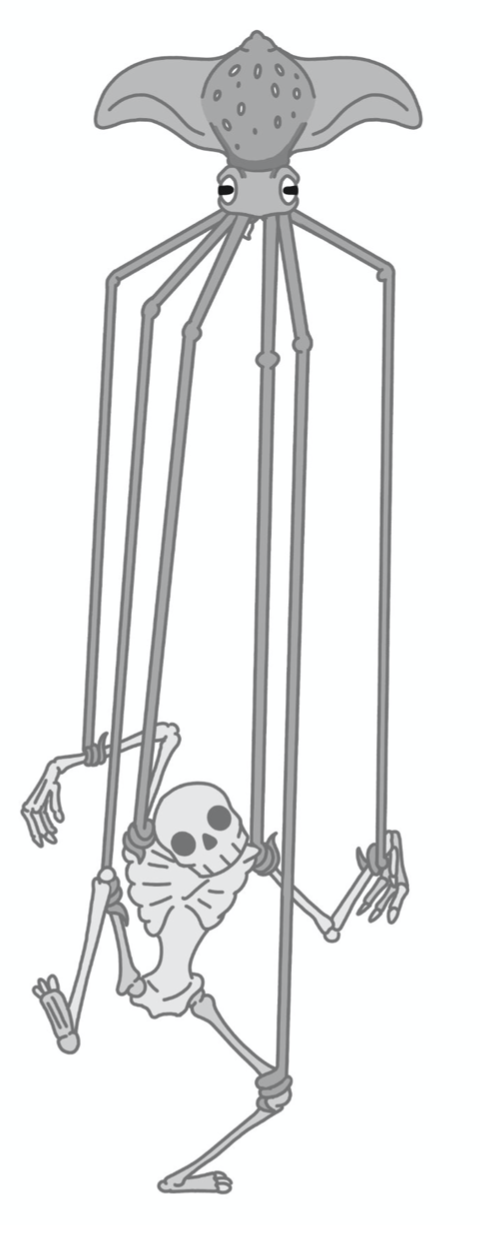
AROS eschews goblins, dragons and all the familiar beasties of bog-standard fantasy RPGs. In their place, AROS offers 42 new monsters to find in the Deep Queen’s Temple (the section, entitled “Creatures of the Deep” is curiously omitted from the table of contents, but this is just another nit). The monsters are statted for Knave but could be converted with a modicum of effort. Almost every monster also has one of the aforementioned Mutations. So if a character eats the Sand of a Dolpod (a dolphinesque humanoid), you have a 25% chance that your forehead expands to make room for resonating space you need in your sinuses and you gain the power of echolocation when you make loud clicking noises. My favorite mutations are of this variety, where the power is telegraphed by physical changes in the Heir. Gaining enough mutations may also impact what happens the Deep Queen is encountered (though for exactly how, you will need to play in or read the adventure for yourself!). There are plenty of excellent monsters listed in AROS to populate the repeated dungeon runs. One of my favorites is the Marionetta Squid, which has a gimmick that the picture alone easily communicates.


Using all new monsters is purposeful for the design of AROS. The monsters not only mesh with the adventure aesthetically—the monsters share an aquatic theme, and not in the lazy way of many D&D aquatic monsters (I have in mind Lacedons and Koalinths)—but also are integral to make repeated excursions into the dungeon a meaningful and engaging experience. When you fight a goblin in D&D, you probably already know what you are getting into. Even if goblins are new to your character, you as a player know their essential characteristics. But how much do you know about a chum? Could you, for instance, distinguish a balloon chum from a tropical chum? Unless you are a veteran of AROS, I suspect the answer is a definitive “no.” In AROS, the Heirs and the players themselves each learn more and more about the ecology of the Deep Queen’s Temple with each run. Because of the “Sand” in AROS, players are encouraged to metagame with this knowledge, as it represents something subsequent Heirs learn from their forebears.

Memory, Metagaming & Mastery

In AROS, when any creature, including a Heir, dies, they leave behind grains of sand, appropriately called “Sand.” When a Heir ingests the Sand, they gain some XP and the memories of that creature. This is how Heirs pass down memories from generation to generation. As AROS explains, “There aren’t any actual rules for this, at least not in the traditional sense. Essentially you can metagame with knowledge from previous runs.” I’m glad that AROS uses the term metagaming if only to allow me to talk about it briefly. 


Metagaming is bandied about as a pejorative term and it is unduly maligned in roleplaying games. Metagaming is an acknowledgement that there is a disconnect between the knowledge of the player and the knowledge of their character as well as a taboo against using exclusively player-knowledge in games. An example in the above-linked Papers & Pencils blog post is the player knowing the effect of fires on trolls while the character has not experienced a troll. The taboo arises in more thespian-oriented games and is verboten because it is an example of breaking character. In the Wikipedia article on the subject, it says that metagaming is “considered unsporting or cheating”, although this claim is both in passive voice (considered by whom?) and followed by a [citation needed]. 


While I agree with my colleague, Nick LS Whelan, on having no qualms with metagaming, AROS is intentionally designed to (1) encourage metagaming-like behavior and (2) justify metagaming such that player knowledge IS character knowledge, for the most part. Because there are no goblins or other recognizable trappings of fantasy RPGs, players and their Heirs start their first run through the dungeon with the same minimal set of knowledge. What is learned about the dungeon, from its contents to its denizens, is passed down from Heir to Heir. There is little that the player knows that their current Heir shouldn’t know equally well. However, while this is not metagaming from a definitional standpoint, it facilitates player-challenge-based play, which is a strength of metagaming. In TTRPGs, typically both the character and the player are being challenged in different ways. While the character may become better equipped to face their challenges through level-ups, finding items or other in-game processes of advancement, the player only has one avenue for advancement: becoming a better player. Mastery of the system, mastery of their character, mastery of the game, all of these improve over time. With repeated runs of the same (or similar, being generated by the same procedure) dungeon, the player gains knowledge that helps them improve at facing the challenges therein. Even outside of AROS, this is fun for some players and groups. What AROS does, and it is a great strength of the adventure, is that it bakes this type of player-challenge-based play into the adventure fictionally. It truly is not metagaming to use the player-knowledge from previous runs in a current or future run through the Deep Queen’s Temple because your Heir has the same knowledge, passed down from the Sand. This fictional conceit is a permission structure for players to embrace player-challenge and dungeon-mastery (of a different sort than is typically meant by “dungeon master”), free from any character-breaking that is considered (presumably, by someone) cheating. In AROS, it would be unsporting to not metagame (and, given AROS’ deadliness, self-sabotaging).


Press F for Action Prompts

While AROS ingeniously integrates its video game inspirations into TTRPG form when it comes to roguelites, there are small portions that feel video-gamey in a less-than-stellar way. This is not a problem unique to AROS; I’ve come across it so often that I have given it a name: the Action Prompt Problem. Action prompts are moments in those quick time events commonly used in video games. They allow a scintilla of player input during largely cinematic sequences, for instance, allowing the player to pay respects during a cutscene of a funeral by pressing a button. In TTRPGs, this impulse manifests itself in referee-facing cues that trigger based on player action that the player is unlikely to actually perform unprompted. Secret information is good, but players should have some reasonable inkling that the secret information is there or a reason to interact with the world in a way that might reveal it. I will go over one example of the Action Prompt Problem in action in AROS, along with a simple “fix” for it. Hopefully this example better illustrates what this problem is, why it is a problem and how to avoid it in writing site-based adventures. 


The weeping statue. In one of the rooms of the Kelp Forest, there is an alcove with a statue of a weeping man, among other things. The referee-facing room description says “If the Heirs wash their face in the tears of the male statue, they can see a path across the abyss [the major feature of the room]. It twists and undulates but provides solid footing.” My issue is simply why would the players wash their face? Investigate the crying statue, sure, but nothing about the statue or the room indicates that this is the time for a skincare routine. Contrast this with the other statue in the room, which the read-aloud text describes as “a statue of a woman holding a small bundle wrapped in seaweed up to her chest. She similarly has water running down her face, but it pools onto the floor and runs into the abyss.” This statue has hidden information (as opposed to secret information; for a taxonomy, check out this excellent post from DIY & Dragons), but it is gleaned simply by “investigating the bundle in the arms of the female statue,” an action thoughtful players are already likely to take. My fix to the face washing prompt is simple: get the players dirty. Either through an ink cloud of one of the creatures that emits it, or have another enemy fling mud at them. When the dirty PCs come to the room with the statues, they do not have a reason to know that either statue has magic face-washing properties, but they at least have a potential reason to want to wash their face. Another solution is just to tell the players, if they so inquire, that the water coming from the male statue looks different than the water from the female statue. But I like the dirty face idea more. Sometimes it is fun when players push a big red button by dumb luck.


Adventure Coherence

Despite a few pedantic nit picks (solely in an attempt to live up to my series’ name, I assure you), AROS is an unusually coherent adventure. That is not to say that other adventures are incoherent in the sense that they are incomprehensible; I mean to say that AROS coheres together to form a unified whole, while I approach other adventurers like a car mechanic in a junkyard, looking for parts to rip out and insert into whatever I’m currently building. I am not sure that there are any specific, discrete parts of AROS I would steal, because each part is so codependent on the rest. AROS is the rare sort of adventure that I would not only consider running, but that I would consider running by the book. Rarer still, AROS’ roguelite elements and its full embrace of the positives of metagaming result in it being an adventure that benefits from repeated games, even with the same group. TL;DR: I recommend AROS to any dungeon-master whose players would enjoy experiencing their own, distinct form of dungeon-mastery.

Where to Find A Rasp of Sand

A Rasp of Sand was written by Dave Cox. It can be obtained in PDF for $10 on itch.io or in softcover for $18 on DriveThruRPG


Folie à Trois: Trophy Gold

Below is a shared review of Trophy Gold (2022) , a fantasy adventure game designed by Jesse Ross and published by The Gauntlet. Although it...