Showing posts with label Dan. Show all posts

Tuesday, January 31, 2023

A Pinch of Salt: Churn Rate

Author: Ian Yusem
Artist: Sajan Rai
Reviewer: Dan D.
System: Mothership
Run as Referee

General Disclaimer: I share a couple discord servers with Ian and we've chatted on occasion.

MANHUNT

Manhunt is a alternate ruleset for Mothership where you play as the monsters, found as part of Hull Breach Vol 01. Four new classes are included: the Broodmother (your classic spawn-producing xenomorph), the Leviathan (gigantic ooze), the Anomaly (weird psychic egg-thing), and the Parasite (a puppeteer worm-centipede). I love these, and their art, and in practice they fulfilled their individual niches excellently.

Instead of gaining Stress, Manuhunt PCs gain Wrath - from killing humans, failing stat checks, and watching fellow aliens die. Hitting 10 Wrath triggers a mutation (some useful, some not), and resets the alien back down to 0. It's a nifty way to get around the general lack of tool usage.


CHURN RATE


I'll warn you up-front, I messed this one up big time - I was rusty as a referee, I was running it right from the book with little prep time, and I forgot a major component of the adventure. Some other factors made everything more of a mess, but those were mostly external factors without much bearing on the module itself. The players still said they had fun, though I can't say I agreed - or that it was entirely the module's fault.

First, the good.

The premise is great: the alien PCs have been captured by a corpo VIP to be imprisoned as trophies on her private space station, and they've just broken out of containment.

Layout is excellent: the adventure is two pages on a single spread, keywords are bolded, room contents are bullet lists. The map is clean and easy to read.

Now the bad.

Churn Rate involves engaging with a heavily-fortified location filled with well-equipped and well-coordinated enemies. You're stuck in tight quarters, with no means of exit (sans the one you need to the Executive's head to activate), and if any witnesses or evidence last an in-game minute the station goes into high alert.

My players immediately revealed themselves, and didn't manage to kill anyone - there were enough agents that, even if they had, the survivor would have sounded the alarm. An in-game minute seems a bit much to me - these are the security crew, they're going to have walkie-talkies.

So we ended up in a situation where the no alert stage wasn't even part of the session. Maybe this could have been avoided, but I think the root of the issue is present in the premise - these are security staff - they're going to have walkie-talkies. All it takes is one of them to hit a button and scream "security breach in [room name]!" and your cover is blown, immediate high alert.

While in the high alert state, all agent encounters are replaced by panicked civilians and the Executive you're after gets taken to the fortified saferoom with the guards stationed outside. I made my critical error here, and didn't make the agent -> civilian switch - the players had to fight through a near-constant stream of agents. It'd make sense, right? They know the aliens are here, split the crew between the saferoom guards and the squads hunting down the aliens.

An agent's standard weapon is a 1d100 damage chaingun, and they patrol in groups. I reduced them to one chaingun per pod, revolvers for the rest, out of necessity - even with the increased damage output and health-restoration abilities of the aliens, it strikes me as too much.

This got to be a problem when we factored in the party train. It makes a regular circuit of the station, visiting almost every room on a 2 minute loop. It's filled with partying corpos, security agents, and a mounted cannon, and it was an absolute pain in the ass every single step of the way. As soon as it was introduced, the players were constantly asking "where's the train?" Which wouldn't have been an issue if I had remembered to swap the agents out, but since I hadn't it was a major combat encounter that was eternally around the next corner. Gods be praised they never actually had to fight it.

There are a few other minor issues - the location of windows is somewhat confusingly worded (they're supposed to be between rooms, but they're not marked on the map - and that also makes stealth basically impossible and is even more things to track), certain interactives are mentioned but never linked to anything (ie draining the steam from the sauna - there's no sign of how to do this)

Final Thoughts

While my own mistakes as Warden made for a worse experience, and I've kept that bias in mind while writing this, I don't think Churn Rate is a very good showcase for the Manhunt rules - the small arena and tight security mean that you don't really get the xenomorph experience that Manhunt sells you. A more open adventure - picking off humans in an isolated colony while dealing with increasing security measures while you try and find the MacGuffin - feels like it would be more appropriate as an introduction.

While escaping from a containment facility is fun on paper, it's a trickier genre than those plans would imply. Whole lot of rather boring SCP stories about violence in indiscernible hallways filled with generic security mooks.

Wednesday, September 7, 2022

A Pinch of Salt: The Drain


The Drain

Author: Ian Yusem
Reviewer: Dan D.
System: Mothership
$4.99 pdf 
Run as Referee
 
General Disclaimer: I share a couple discord servers with Ian and we've chatted on occasion.
 

Part 0: The Introduction

I return to this post three quarters of a year after I first drafted it. I had hoped to get a second session of it played, but it was never to be. Say la vee.

Part 1: The Module

The Drain is a 16 page 0-level funnel for Mothership, where the players take the role of prisoners in a Bible-school reform prison tasked with recovering a relic from a collapsing colony habitat in exchange for clearing their remaining sentences. The habitat is presented as a pointcrawl on an inverted cone, which handily makes for a very nice looking map.

Pregen characters, blank sheets, and some mp3 files of creepy radio chatter are provided (alas, I wasn't able to use this last one). Character sheets have art by Evlyn Moreau, module art is Sean McCoy's instantly-recognizable scribble art, and map by Andrew Walter - it's all excellent.

The Vibes are strong here. Prisoners wearing tinsel halos. Horrible fucked-up meat monsters. The feeling of unease when you're driving a country road in mid summer and seeing signs about Jesus opposite houses that you can't ever imagine being new or whole or unrotten.

The writing is what you hope for in a Mothership module - tables, bullet points, bolded key terms.


Part 2: In Play

The opening of the module - unarmed prisoners disgorged from boarding craft into an open battlefield - is effective imagery but it works less well in practice. You're instructed to roll for two gas clouds per stretch of no man's land (three stretches in total), but it's unclear as to whether or not they were to be simultaneous, sequential, or choose 1. I had to fudge the first roll of the session because one of my players would have lost all four of their characters instantly to nerve gas.

I feel the influence of the first stage of Deep Carbon Observatory, but here it's just "You're in a trench, now you're making saves against gas, now you're in another trench, now you're making saves again". One cycle was more than sufficient, and by the third and final I was getting bored with the repetition. Not a good place to be for an opening.

Moving past the battlefield, the players reached an abandoned farmstead, where they found  a remote capable of shaping the nanite-infused soil of the station. Single sentence description, no mechanical interaction.

It swiftly became the highlight of the entire session. In the next encounter (an open field with a sniper up on a billboard) they were building earthworks for cover and raised a tower with a ramp to reach the abandoned VTOL hovering above the field. It was some fantastic tool-based problem solving, the sort of ideal RPG scenario.

The session ended with the players squeezing the surviving prisoners onto the VTOL, and which would allow them to cross the river into the ring. Unfortunately, due to scheduling issues among the players, I was never able to gather folks for the second half (and this post laid fallow nor nine months).

Had I played further, I would likely have started throwing in consequences for the time-cost of using the remote, but even then not too much - folks were having a great time.

As random encounters only occur when moving to a new area, I pre-rolled them and any supply caches earlier in the day, which made things nice and smooth (and was an entertaining enough way of wasting time at work)


Part 3: In Summary

In the time since I've played, The Drain has been expanded to a trilogy (alongside Inferno and Wrath of God). I have not looked into the other two parts (there is so much Mothership stuff out there), but I feel like I would check them out if the mood takes me.

Would I run it again? I would with a revision of the opening sequence - possibly adding some variable or choice for the players. Do you run for the shelled structure, or to the treeline? Something of that nature. But the rest of it was fun, I'd give it a thumbs-up.


Monday, February 21, 2022

A Pinch of Salt: Ekphrastic Beasts


  • Reviewer: Dan D.
  • Author: Janaka Stucky
  • Art: Ellie Gille, Jeremy Hush, Joe Keinberger, Nathan Reidt, Arik Roper, Skinner
  • System: D&D 5e
  • Physical copy received as gift from third party
  • Read, unused


Bucking all predictability, I am reviewing a 5e product for this Pinch of Salt. I am a maverick who must be stopped, soon there will be anarchy in the streets, cats and dogs living in harmony, etc etc.

Now, this obviously means there's a rather large bias to get out of the way. I will do my best, and likely fail, at passing by the aspects of 5e that would send me down a rabbit hole of yelling into the void. I am judging on a curve, and I am not going to read the stat blocks. This book is not designed for me, take that as you will.


What I am Looking For


As this is a bestiary, I have a rather concise list of things I am looking for and making judgements upon.

  • Image - Does the monster have an interesting/noteworthy/memorable visual appearance (via art or description)?
  • Concept - What a monster is and does outside of appearance. If I was telling you about a monster without the book on hand, would my description be cool?
  • Connectivity - How does the monster fit in and interact with the world? What is its relationship to the environment, other creatures, and human beings?


The best bestiary entries, I feel, are the ones that provide a scenario that gives context to the encounter with the creature. If the intended interaction is combat, then there needs to be reasons for why, some sort of link between the monster and the surrounding world - "it's an evil monster" is worse connectivity than "its home river has been polluted and it is angry and sick".

An entry can get by with middling image and concept and good connectivity, but the reverse is rarely true, and all three is a welcome break from the trend.

(Now, these three points might seem to lend themselves to a sort of point-scoring system. I do not like point scoring systems, so these will remain the mere impression of one.)


The Opening


The book opens with a sizable forward by the author describing how the book came to be and some of the nature of its contents. While this is a nice touch, I do think that it ran entirely too long for the amount of context it provided.

Most noteworthy is the bit on how the implied setting behind the book took shape as the creatures were being written. I did appreciate these points of tying things together, but I tended to find that they only went one way: entries could directly reference backwards, but never forwards (for example, the Xivvians directly reference their servants the Lamplighters by name, but the Lamplighters do not mention the Xivvians.)


What's In a Name


Ekphrasis is the act of a vivid textual description of visual art. It is a very nice and cromulent word, but for all the focus it gets in the forward it is unfortunately absent from this book - the art carries all the legwork and I found the words to be weak overall. The writeups fall afoul of the bane of bestiaries everywhere, filler. Lots of words spent on how dangerous something is, when that is readily communicated by concept and appearance alone. Many monsters have their writeups truncated even further still by the size of their stat blocks, or by the addition of pencil sketches that eat up a column, or just leaving the column mostly blank.

The art itself is of varied but overall above average quality thanks to Ellie Gille's dark fairy-tale watercolors and Joe Kineberger's chaotic grotty messes, which are standouts. Unfortunately the other pieces give it a more uneven visual quality, especially later on with the Xivvians, where there is a cluster of works by the same artist on the same subject.


The Monsters


Arrikath - A cackling demon, and that's about it. There is the mention that some wizards will summon it, but the description does not tell us why they would or what they would get out of it. Few are the wizards who will summon a cackling demon simply for kicks and giggles, they should be looking for something only this demon can provide. It's the core principle of demon summoning.

Azithaenth - The description is good - predatory shadowy monsters that arrived with a rain of meteorite impacts, that have been nearly driven to extinction by organized hunting efforts. Solid concept here, I can imagine a rural township digging up what they think is just a huge chunk of iron and unwittingly releasing one of these. Let down by the art on this one, though, for reasons I cannot describe.

Bellmodeth - A wee demon who hunts down folks who have reneged on their contracts. Not much more than that. Does imply a setting where deals with devils are relatively commonplace, would have been nice to have had something else enforcing that in the book.

Bezglazzy - Creepy bogie in the woods who steals eyes. I was confused as to whether or not it was a unique monster. Did not have really any good ways of onboarding the thing, it mostly keeps to itself and you're most likely to just stumble upon it in the deep woods. Which is fine and good I suppose.

Bog Hag - Fey of the swamps that turned monstrous after the humans arrived and the trauma of having their homes stolen was internalized as festering hatred and sorrow. Now they lurk at the edges of settlements, devouring unlucky travelers and wayward children.

Böogrú - A minor old god summoned by pagans up in the hills, needs steady blood sacrifice to remain appeased. I like this one - gives off the idea that some cult long ago fucked up royally and now the descendants have to disappear people on the regular to deal with the problem their predecessor's caused. It can tie neatly into "the cult has disbanded, no one is feeding it, it's on the prowl." Good stuff, I can work with it.

Changeling
- I feel like this one didn't need a separate entry, as its linked intrinsically to the bog hags. To whit, these changelings come about when a bog hag devours an infant and then gives birth to its changeling double, which is horrifically gross and I approve of it. Everything else is just normal changeling stuff, though.

Chiropterror - I keep calling them chiropractors in my head. Unavoidable I think. Here we get a somewhat anomalous (though more appear later) segment of italicized prose. There is no omniscient narrator description. They're nasty little cave monsters, and I do love me some horrible things in the dark, which makes me wonder why they are here because 5e is not a dying in caves game. But they would be a fine fit for a Jacob Geller video.

Daemdirisi - A unique entity, being an ancient warchief who was resurrected (foolishly) by the tribe's shaman, to predictable results. This is another one where I can see the hooks: the few remaining descendants of that people, the pressing threat of the past haunting the now. You have a good, solid reason to go track it down and fight it. I really like this one.

Death's Head Shrike - Skull-headed bird. Human skull, not bird skull. All birds have bird skulls as their head, except these, which do not. A swarm animal. Nothing to see here. Nothing of note.

Deepsea Wight - Love the art on this one; nasty gelatinous abyssopelagic undead. Mention of the fact that they will drag themselves onto land or on deck wins some huge bonus points for creep factor.

Den Mother - Ents are tree-shepherds, Den Mothers are that for wolves. I love the idea, but it's wasted as a bestiary entry. Would be much more interesting as an NPC.

Disciple of the Morning Star - Necromancer cultists in their tombs filled with terrible goodies. They have apparently been mostly erased from the historical record (entry says that very few institutions keep record of them, and those that do keep it restricted), and that to me says that what they actually did was interesting. We do not get that information, which is a shame.

Dream Serpent - Sleepy dream-hoarding dragon. No real hooks, unfortunately.

Drosyrad - Bog nymph, nothing of note.

Fibroh - This is just a goblin. It's a fairy goblin, a Midsummer Night's Eve type of goblin, but goblins is goblins and this is one of them.

Fire Sentinel - Enormous magmatic giants that burst up from the earth's mantle for the express purpose of "fuck this place in particular". 4/5ths of the page is their stat block, which is the first instance here of an unfortunately common trend in bestiaries, especially 5e ones: including stat blocks for entities that no one in their right mind would fight, because they are instant death.

Foundling - Feral children. Unfortunately, there isn't anything to them beyond that, just ordinary feral children. No strange gods or weird gang rituals or anything of that note. As someone who is also writing about feral children, I must register my disappointment.

Golkih - Fills a kobold niche, I suppose. Weird nasty dog thing, up in the mountains. Nothing of interest.

Grinlene - A variety of vengeful undead, undermined by the fact that there is no telling what causes them to happen. Possibly a drowned woman? So close, we could have had a build-it-yourself whodunnit adventure out of this monster but the text is silent as to the cause and place of death.

Hàskis - A column of ash with a burning skull on it. Would be a nothing of note entry, were it not for the fact that the text proposes the "legends" that they are either trolls that got dunked in magma and have been perpetually burning ever sense, or engineered hunting dogs for fire giant sorcerers. Both of these are great, except for how they are couched in "legends say", thus making the interesting part suspect in its veracity. Combine the two concepts and you have a killer monster idea, but hiding behind "legend says" implicitly tells the audience that these theories are not the case.

Horyx - Beast-headed men, warriors from afar. Could have said where they are from, or why they are here, but there is nothing.

Iwsii - Fey oracles. I like the design and the art, but they would be rather clumsy to fit into adventures.

Keyhoarder - Another creature that should be an NPC. A fey that loves gathering secrets. If the secret is locked away, they will steal the key. The write-up does say that one can and likely should make deals with them to get places, but continues on to spend half the page on a stat block instead of fleshing out the magic merchant aspect.

Kithrui Ghaisha - Possibly my favorite monster in the book. I really like this one for its clarity of concept - a big nasty demon that is drawn to sites of catastrophe and loss, feeding on all that bad mojo and then using the deaths of everyone who fails to kill it to keep on going. This is good! Actionable monster with roots in the world.

Kythys & Mhaothon - Gods with statblocks. Hard pass from me, don't truck with that. Another entry no one would fight.

Lamplighter - Overwhelmed by their concept. Protohuman sorcerers who astral-projected into the void, were seen and consumed by Spooky Alien Forces, now acting as servants and beacons in the world. Great for flavor, but I feel like I need some serious elbow grease to find a place to put them.

Murúch - Basically a siren or mermaid that disguises itself as a large fish, gets hauled up by the fishermen, and starts eating people. Likely a monster one hears about in retrospect and then specifically goes out to hunt, which is good.

Nagaraja - Enormous primordial serpents. There is no reason to fight this, or interact with it at all.

Plague Knight - Undead fascist crusaders. Ended up undead because they were playing around with occult powers and blew themselves up, which is funny. The plague aspect seems tacked on, though, it's got nothing really to do with the backstory.

Răzbuna - A nifty concept. Horrible monster caused when you kill a wolfpack leader, would tie in very nicely with the Den Mothers, and also gets a bonus for being a monster that feels like it has some real folkloric feet to stand on. I could imagine hearing this in a book of traditional stories from somewhere in the real world.

Reanimaggot - Pretty typical shambling undead, but the name is fun and they're nice and gross.

Rüu Gisin - Frog knights, but with no real way to interact. They're just the size of normal frogs and their only listed behavior is "protecting their home", which is hardly anything unique among the animal kingdom.

Scroll Keeper - I am a sucker for libraries at the center of the multiverse, but these guys are ill-served. The random table of scrolls have potentially fun titles like "Scroll of Political Discourse" and "Scroll of Mechanical Physics", but all they give is like a +2 to a skill.

Sea Shepherd - Like an ent, but a giant, and for the ocean. No reason to fight them. More an aspect of landscape than anything else.

Sel'gorach - Unique monster, duchess of hell, love the art (possibly my favorite of the book), the description tells us nothing of value. The big scary dangerous demon is big, scary, dangerous, and a demon. Also she cannot fly.

Spider Queen - What it says on the tin. Only real difference is that it looks mostly like a human, most of the time.

Strix - Bonus points for giving Lilith the proper screech owl rep she deserves. Doesn't really have anything to do, though.

Thounquis - Killer concept - island civilization ruled by necromancers, whose beaches are patrolled by these corpse-amalgamation monsters. Yes please, I love it, I would like to know more. The art is a let down, though, it's just kinda a multiheaded zombie in the black cloak. The concept carries it, without the island of the necromancers it would be quite dull.

Thoz'gorin - Centauroid battle demons. Nothing of note

Tomb of the Ancients - An inanimate object with stats. Brief mentions of horrible treasures of the old gods within, none of which are actually provided. A shame, because the text sets them up as loci for weird events and leftover arcane knowledge and terrible entropic/mutagenic effects.

Transdimensional Dragon - It has an ability called "Pure Witness of Quantum Revelation", which is rad, but again we must ask in what circumstances would anyone both want to fight this and reach any outcome that isn't false vacuum collapse localized entirely within your kitchen.

Unholy Creeper
- Carnivorous plants on desecrated ground. Would honestly be better served as part of the writeup of potential hazards in desecrated ground.

Xivvians - My least favorite part of the book. A subsection of extradimensional flesh monsters that are following the Lamplighters to our world, fair enough. But the section just goes on for so long, with so many different varieties, and the art swiftly gets repetitive on top of being a step down from the other pieces. There's very little differentiation between the monsters, and the descriptions are rarely on the same page as the picture (a shift from the entire rest of the book). lots of talk of stuff no character will ever see, learn, or use. Artifacts mentioned, no list given. Overstays its welcome. All the names and forms blur together.

Ysherosz - So, so close. A "kingmaker" demon that is attracted to those who value power over all else. Let down by the fact that it possesses the victim, rather than a more engaging conflict point of someone making more and more heinous acts to please it. Making it an unvarnished possession makes it too smooth and neat.

Zhizhutu - A human head, but with spider legs.

All told, there are 16 aberrations, 5 beasts, 1 construct, 2 dragons, 9 fey, 7 fiends, 3 giants, 6 humanoids (which is silly, since they include the frog knights as humanoid), 6 monstrosities, 2 plants, and 7 undead.

Best in Show: Bog Hag, Böogrú, Daemdirisi, Den Mother/Răzbuna, Kithrui Ghaisa - I could plug these into a map with basically no elbow grease and it would work. All of these have strong enough hooks that I could make a scenario out of them with hardly any work on my part, and that's gold star material.


Final Thoughts

I'm saddened somewhat. The desire to make good art is here, and in many places shines through brilliantly, but it is hamstrung and stymied at every point by its attempts to fit in with a format that does not serve its strengths and multiplies its weaknesses. It falls short of its goals because of the mold it's been forced into, which is a major problem for an art book.

I'd like to get an answer from the author, or anyone else who is in-tune with the design philosophies of the 5e sphere - what is the motivation behind including stats for what should be instant-kill entities, or those that there would otherwise be no reason to fight? Is there an expectation that players will regularly be in an appropriate power range to fight these? Is it an obligation to keep with the 5e format? I legitimately don't understand. I get why it was made for 5e, but I don't get why that must entail making the exact same mistakes. The forward has a section addressing things like alignment issues, but alignment is still in the stat block. Saying that something is a problem and then doing it anyway doesn't solve the problem.

A cautionary lesson, I suppose.


Monday, October 18, 2021

Cryptic Signals - Dissident Whispers


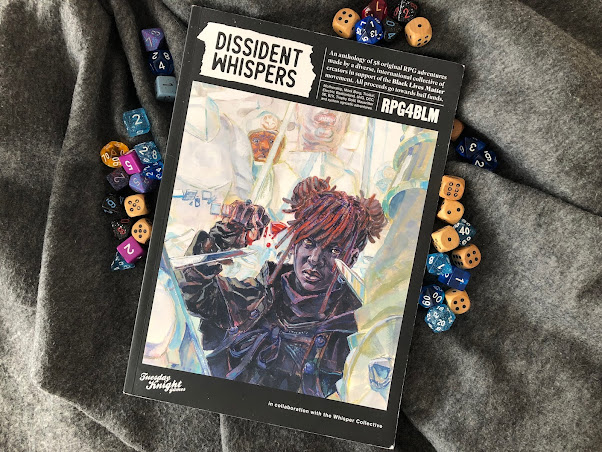
Last year, a white police officer murdered George Floyd on camera, which set in motion uprisings by the Black Lives Matter movement across the United States and around the world. Despite the remarkably nonviolent nature of these demonstrations, over 10,000 protestors were arrested by the very police whose egregious abuse of power they were protesting. Many organizations and communities organized in support of the protests. One such effort, led by the Whisper Collective, produced Dissident Whispers. All proceeds from the project go towards bail funds, supporting all those arrested for standing up for Black Lives Matter.

Dissident Whispers is an anthology of 58 TTRPG adventures, produced by Tuesday Knight Games in collaboration with the Whisper Collective, made possible through the collaboration of over 90 artists, writers, editors and designers. This issue of Cryptic Signals will not review every adventure in Dissident Whispers, but focuses on a few that catch our individual sets of eyes.

...


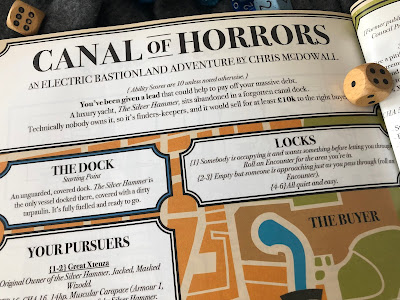
Canal of Horrors (Review by WFS)

Canal of Horrors is an adventure for Electric Bastionland by Chris McDowall. Like most adventures in the Dissident Whispers anthology, Canal of Horrors is short and sweet, fitting on a two-page spread. It consists of a map of several boroughs of Bastion (“The only city that matters”), annotated with details about each borough and a simple adventure hook and things that get in the way. In short, it has everything needed to inspire an adventure. 

McDowall is often praised for his terse style, both in his advice and his rules. He has a much-lauded ability to cut rules to the core. As Anne of DIY & Dragons said, 

I consider Into the Odd to be something like the Platonic ideal of simple Dungeons & Dragons. Both the rules and the writing have been distilled down to their very essence and presented in the tersest, most compact possible way, without sacrificing the elements that are most essential to play. I'm not saying that no one else can write something better than I2TO, but I am saying that you'd be hard pressed to write something shorter. Chris McDowell has seemingly cut out everything but the most necessary elements of D&D, and edited his own writing to be as terse as possible.” 

What goes less-often commented on is that McDowall is one of the funniest writers in TTRPGs. While his description of the “Rich Future Bastard Versions of You” pursuing the player-characters cracked me up the most, almost every entry in Canal of Horrors matches the understated comedic tone. It isn’t trying to be funny; it just is. The worldbuilding hits the right mix of absurd and mundane, and the tone remains firmly tongue-in-cheek. Like the rest of the Electric Basionland canon, the droll writing makes Canal of Horrors a pleasant reading experience.

But how does it play? You are in luck. I ran this adventure as an intermezzo between a starting adventure in a Bastionland hospital and You Got a Job on the Garbage Barge (a play report, of sorts, is here). However, my problems with the adventure are best illustrated by the changes I made. In Canal of Horrors, the player characters begin at the docks. There is an abandoned luxury yacht. To get paid, the characters need to take the boat through the canals to the Buyer at the intersection of Mocktown and the Central Bog boroughs. The canal itself is forked like a trident, but it is a straight path to the Buyer. I always pay attention when designers break their own rules, and in Electric Bastionland, McDowall provides the following advice about mapping Bastion: “draw two or more circuits denoting different transport routes, ensuring they cross over each other.” There is no circuitry here, and players don’t really need to make any interesting navigational choices to get from the starting point to the end. Essentially, it is a railroad with five locks between start to end, with each lock having a 50% chance of triggering an encounter. So I flipped the adventure geographically (partially as a necessary way of shoehorning in the Garbage Barge), but also provided multiple routes through this section of the city. My players ended up crossing bridges on foot, taking cable cars, and swimming in the canals as they made their way from a privatized hospital north Mocktown to the Dock to the south. The worldbuilding and writing of the adventure drew me in, but the adventure structure itself is lacking (perhaps to be expected, based on the real estate the adventure covers [several city districts] versus its real estate in the book [two aesthetically pleasing pages]). Like many adventures, it takes some tailoring to make Canal of Horrors as flattering as it can be when you bring it to your gaming table.


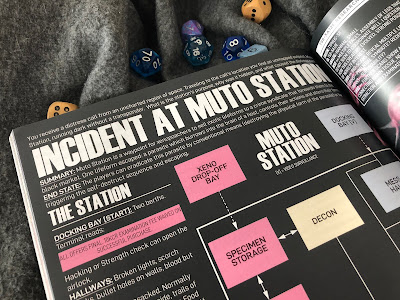
Muto Station (Review by Dan D.)

The Incident at Muto Station is a Mothership adventure by Brian Hauffer, which I ran for three players who had no experience at all with the system to great success. It’s a rather simple setup - here is a creepy, if linear, abandoned space station, there is a horrible monster onboard it - but that's fine for a one-shot. It doesn’t have much in the way of reason to get involved, other than a brief mention of it being a place for poachers to drop off ill-gotten xenos for sale, so when I ran it, I framed it as a cleanup job, grabbing some data and scrubbing the rest under the auspices of a shady patron. Worked like a charm. The monster is big and gribbly and has a table of behaviors and tricks, plus a much-appreciated note that it will start cutting off escape attempts when the players try to leave (as there’s not much stopping them otherwise). 

The players had fun, it was easy to run, and that’s fine enough for me.


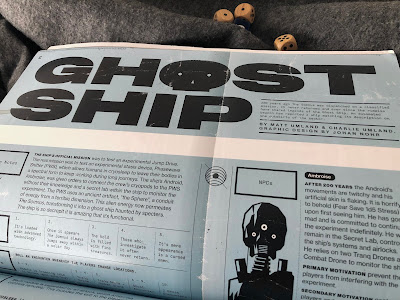
 Ghost Ship (Review by mv)

*

Ghost Ship is a module for Mothership by Matt and Charlie Umland. This 2 page spread promises a paranormal exploration of a long forgotten derelict. “Those who investigate it often never return”  - we are warned right off the bat. OoOOooo. Rotate 90 degrees, we got the classic badly kept poster (terrifying), maybe a blueprint - clear yet grungy design by Jonah Nohr (known for Mörk Borg). 

**

Ghost(s) / are the main / supernatural / part of this / Ship. Encounters with them are randomly generated, so it took some improvisation to make them fit into the various rooms of the ship. However it was super fun to be surprised by the creepy specters I’ve rolled up. One thing to watch out for are possessions. There are two random table entries that have the ghosts possess PCs and deal harm, and one ghost who possesses to speak. They are not in any way baked in the overall plot of the module, so you can decide with other players if you want to use these entries or not.

***

I ran the module using Ian Yusem’s funnel rules from The Drain. The players used their numbers to split off and explore various rooms simultaneously, which made the session feel like a true haunted house horror flick. Encounters with the ghosts were spooky and memorable, but the turret traps felt a bit out of place when there is such a cool paranormal premise. After the ship was cleared, the players were left with a lot of hooks to follow up on. What’s up with the weird sphere? What to do with the expensive equipment? Where to transport the survivors?

****

10/10 would get haunted by space ghosts again.

...


Dust Remains (review by Anne)

A few years ago, I was running a weird west Dungeon Crawl Classics campaign where I went searching for mine-themed adventures to reskin and convert to DCC. I used Melancholies & Mirth’s Abandoned Mines Above the Caverns procedural generator, reskinned Into the Odd’s Iron Coral as “The Irontown Corral,” and even started in on Goodberry Monthly’s Goldsoul Mines before my play group moved on to other things. If I had known about “Dust Remains” at that time, it definitely would have made my list to try, and might have beaten out one of the others.

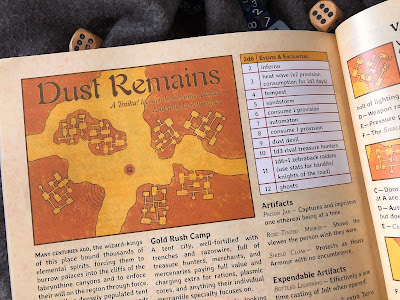
Christian Kessler pushes the two-page format to probably its absolute limit, giving us a mini-setting on one page and SIX mini dungeons on the other. In the extra space, Christian finds room to give us a table of encounters, four new monsters, a list of ghosts, a random table of minor treasures, and 11 unique magic items and spells, all written up for Troika and other descendants of Fighting Fantasy.

“Dust Remains” presents us with a series of ancient tombs, left over from an empire of cruel wizard kings, carved into the cliff faces of a winding canyon. The area is still haunted by elemental spirits who escaped from their long-ago enslavement, and by the zebra riding nomads who claim to be the empire’s only survivors. Some of these details, along with the names of the tombs - “Vault of Enuliki” or “Vault of Mazzolamus” for example - make me think the setting is meant to be fantasy Africa. There’s a tent city of wannabe tomb robbers and the various merchants and traders that accompany any gold rush, and a second camp of “rich fucks desiring ancient artifacts as status symbols” who provide an immediate market.

The flavor of the various treasures and the activities of the ghosts (which show typical actions of the long-dead imperials) help to communicate the distant culture of the ancient empire. The dungeon keys consist mostly of traps and puzzles, plus a list of treasures behind the final door at the back of each vault. The variety Christian presents is impressive, although the referee will likely want to add a bit more to each dungeon to bring them to life and give them a true sense of exploration. The referee will also need to create NPCs to populate the groups described in the setting introduction. Given all that Christian manages to fit into the available space though, I think these limitations are understandable.

The greatest flaw in “Dust Remains” is the maps, which are almost unreadable. The region contains two different encampments plus all six dungeons. I’m not sure which camp is shown or where the second one is located. The dungeon maps are reproduced in slightly smaller form on the second page, where a handful of the rooms are keyed. At that size, and with the very thin font used on the key, it’s very difficult to make out where anything is supposed to be. Christian’s instructions for randomly stocking any unkeyed rooms also ask the referee to differentiate between “accessible” and “inaccessible” rooms, a distinction I’m not sure I can make quickly at a glance. 

If I had a second quibble, it would be that the anticipated time frame of the “Events & Encounters” table isn’t specified and seems unclear. I would guess you’re meant to check daily, because that’s the only way certain results make sense, but others seem a better fit for checking on expedition time.

...


Lair of the Glassmakers (Review by Ava)

I ran Lair of the Glassmakers for a group of 4, mostly new players, using Into the Odd. I selected this particular adventure as I felt the rooms full of inventive, creative puzzles and the adventure themed around cute, mischievous glass kobolds (visually depicted in a pixel art style that reminds one of Pokemon by way of Moomin) would be a good intro for a group of queers who had never played D&D before and were used to the softer fantasy of the new She-Ra cartoon.

I was mistaken. Lair of the Glassmakers is, if run as written, an absolute meat grinder.

The rooms are, as previously mentioned, full of interactive elements and fun puzzles. There’s an alchemy mini-game, and reflections that are alive, and an Annoying Fucking Cat who is literally designed to create hijinks and chaos. This is all really great. If the dungeon was actually just what was keyed within the rooms and nothing else, no denizens, it would actually make for a really fun, if low-stakes, little puzzle-solving session.

The failure of this to all cohere comes in the way random encounters are implemented, and the denizens of this particular dungeon.

The dungeon is the workshop of a glassmaker and alchemist. It is full of treasure, which adventurers will want to ransack. Every room contains, as a random encounter, d6-1 glass kobolds (the entryway to the dungeon, not a keyed location on the map, also has 4 glass kobolds in it). These kobolds surprise on a 2 in 6 (3 in 6 first time they’re encountered) and if they surprise, they each nick an item from the players after which it ends up in the bedroom.

This setup strains credulity for me a little bit already. In the first case, it isn’t quite clear how the stolen items end up in the bedroom. The most logical reading of it is that the kobolds run off with the stolen items to the bedroom but: why? And how does one handle this running off? Do they do it at the beginning of the encounter, absconding in a Road Runner-esque fashion before the PCs have time to react? What if the PCs plan for this and try to catch the kobolds before they run off? And what becomes of these fleeing kobolds? Do they linger in the room next to the bedroom? Do they disappear into the ether? Am I supposed to roll for how many kobolds are in each room each time the players enter any room, or just the once? These might seem like petty questions that any GM worth their salt could make a ruling on, but this sort of nebulous quantum amount of kobolds that always end up teleporting stolen goods into a bedroom strained my credulity, and undermined my sense of this location as a coherent space. 

But of course, that only occurs when the kobolds surprise the PCs. The other 67% of the time, what do they do? Well, they guard the place from intruders who want to mess up the workshop or steal from it, and guard its owner Elsa with their lives. No morale rating is given (which feels odd; the module is labelled system agnostic but gives AC values as Plate or Leather and Levels as Thieves or Magic User, so its clearly working with OSR systems in mind), so this seems to imply fanatical glass kobolds that will fight any adventurers to the death. With several of them in every room, confrontations are bloody and frequent. For the low level characters this module is recommended for, this would be a meatgrinder.

The space is small enough (8 rooms all jammed close to each other) that random encounters aren’t really necessary in order to provide a sense of risk to orienteering: it would have been better served with a definite amount of glass kobolds keyed to each room, preferably engaging in distinct but cute hijinks which provide PCs a method of interacting with the kobolds that isn’t wholesale slaughter.

The only other inhabitant of the dungeon, Elsa the glassblower/alchemist, isn’t much better. She hides as an imperceptible glass statue (undetectable without detect magic), and she will only act if she feels the players are messing with her space, in which case she attacks them (dealing 3x damage on a surprise, which she has a 4 in 6 chance of). So this character, potentially the most interesting person to interact with, certainly the only person to parlay with if you want to be friendly with the kobolds, has two states: 1) unable to be interacted with whatsoever or 2) murdering the party. Oh and also she’s in the very first room of the dungeon, so the players will almost certainly be immediately attacked, being drawn into an ambush against a 5HD creature and d6-1 kobolds at the very beginning of the adventure.

Really, with there basically being two types of inhabitants in this dungeon (mook and boss) that are all singularly aligned to common purpose, this can’t really be classified as a dungeon at all. It’s a faction lair, and should be treated as such. The only way to get through it for a party of players is directed assault which requires foreplanning, or placed in relation to other faction lairs so as to allow emergent social play from competing agendas and goals. 

...


Dissident Whispers was produced by the Whisper Collective, in coordination with 90 individual collaborators. It is available in Print & PDF for $30 at Tuesday Knight Games (North America), in PDF for $20 at itch.io or DriveThruRPG. Physical copies outside of North America were previously being distributed by Melsonian Arts Council, but as of time of writing that option is no longer available. 


Wednesday, October 6, 2021

A Pinch of Salt: The Words and Deeds of the Chain of Tlachic


The Words and Deeds of the Chain of Tlachic

Joe Young & Vivian Johnson
System agnostic
Physical copy received as gift from third party
Read, unplayed

**

I'd not heard of Chain of Tlachic before receiving it, and I haven't heard anyone mention it since. It opens with the following phrase:

"THIS BOOK IS VULNERABLE, DISPOSABLE, AND CURSED."  

It's part of a longer exhortation to take a pen to the book and write over what is already in it, and what will come to be the defining feature of this adventure. We'll get to that in a bit.

Chain of Tlachic is a 55 page megadungeon. Or, rather, it is what I am here and now calling a micromega dungeon - an environment that gives the impression of grand scope and scale but is nice and compact in practice. A megadungeon that it is conceivable to read and use with busy adults in 2-3 hour bites.

(A personal aside: I adore these sorts of dungeons, when compared to their larger counterparts.)

 Each of the 17 areas of the dungeon consists of a two-page spread, containing:

  • Artwork of the area
  • Single-paragraph description of the area
  • The primary threat of the area, including the tactical difficulty and numbers
  • Dynamic elements found in the area
  • Potential developments / responses to player actions in the area
  • Connections with other areas

The book hinges on those last three points. In lieu of providing any mechanics or traditional room keys, Chain of Tlachic puts its primary focus on the relationships between factions, monsters, places, and things, and how they effect one another. Nothing stays the same; actions taken here will have influence there. Returning to an area will reveal a place different from when you first came through. It's not a new concept, but it is very refreshing to have a book that sheds mostly anything that could get in the way.

The "mark up this book" notice from the beginning comes back here - practically, it's the easiest way to keep track of what changes have been effected. In doing so, each copy of the book will, over the course of play, become a unique artifact. The book is the notes, and this is explicitly intentional.

(And let us always praise two page spreads. Less page turning = less problems.)

**

The framework of a Chain of Tlachic campaign is that the players are dwarves - constructed servants of the god Tlachic - attempting to reclaim the depths beneath their fortress from the Red Lady. If a dwarf dies, they are reborn in the Stronghold at the top of the map. This is a simple set up, and sufficient for dealing both with why players are in the dungeon and the inevitable deaths and reshuffled schedules that come with any campaign. It would be possible, I suppose, to play through this module using normal, non-dwarf characters. I wouldn't recommend it - something feels like it would be lost.

The book-as-notes-as-artifact approach requires either a physical copy or a print-out the pdf. It would run fine enough without engaging with that element, or to mark up the pdf, but I feel that would miss something.  Maybe that's just me wanting to be in line with the spirit of the thing.

**

On to the less novel and appealing - Spelling and grammar mistakes are common throughout, and the art can often get muddy and difficult to parse. Encouraging readers to mark up the book means these are solvable problems (they would have been solvable problems regardless, but it's nice to have authors who are vibing on the same wavelength), but that doesn't stop them from existing in the first place. 

More pressingly, the four artifacts that have a major effect on the final conflict with the Red Lady are only brought up as such in that final segment of the book - not when the items actually appear in the dungeon. There are likely other such missing connections in the book, less important and less noticeable, but this is a pretty critical oversight for a dungeon so focused on those connections. Sure it's fixable, and would be whether or not I had direction to draw in the book, but I'd rather not have to fix something central to the adventure.

**

To wrap this up (since I feel like I have hit the point of going in circles should I keep going) what I like best about the Chain of Tlachic is that it is rough around the edges. It is the sort of awkward amateur work that is the lifeblood of a healthy artistic scene, and I'll recycle a quote from Noah Caldwell-Gervais:

"Most players are willing to forgive anything a game actually does if they’re enamored with what a game wants to do”

Sounds about right for this.


Tuesday, July 13, 2021

A Pinch of Salt: Lair of the Lamb


Lair of the Lamb

Reviwer: Dan D.
Author: Arnold K
System: GLOG
Free pdf
Run as Referee (using home rules)

**

Up front I think I should note that Arnold is literally the reason I am part of this scene at all - Goblin Punch was my introduction to the OSR and it was Arnold's comments on my own blog that got me properly involved in the G+ scene back in the day.

Right then, that's out of the way.

Part 1: The Module

Lair of the Lamb is a free 51 page pdf containing a 46-room dungeon and the core rules for Arnold's revised Goblin Laws of Gaming. I will be focusing primarily on the first half of the dungeon itself - while I am fond of the GLOG and its infectious spread around the blogosphere I didn't use it while running the Lair, and I likewise did not use the expanded second floor with the ghouls.

Lair of the Lamb is a funnel and teaching dungeon - every player gets a handful of level 0 peasants who die in one hit. Everyone wakes up in a pitch black room with no possessions. There's a monster in here with you. Get out if you can. Dungeoncrawling is reduced to its core elements: light management, risk assessment, using the tools at one's disposal, creative solutions. Since tools are so rare, squeezing every possible use out of them is necessary. Since challenges are open ended, those unusual uses are rewarded.

(An example of an open-ended challenge: a sarcophagus with a false bottom. There's a room below filled with treasure, but it's a 10 foot drop. The edges of the sarcophagus are sharp enough to slice ropes.)

Room descriptions are minimalist - things of note in bold, NPCs in red, treasure in green, bullet points. Good, easily readable formatting. Each page has the relevant subsection of the map up in the corner. Precisely as much description as the room warrants (a supply closet, for example, is described only as "Broom, Gong, and Hammer"), but nonetheless is evocative in that short space - "A throne of sheep bones and unfired clay", "A golden sensory deprivation helmet", "A mural of a crab being groomed on a woman's lap", "[The Lamb] reeks of blood and ammonia", and so on. Single sentences, nothing fancy, more than enough to work with. I could add additional details as I saw fit or let them pass on by without issue.

The art is minimal - some public domain images, a drawing of the Lamb by Warren D, and some illustrations of classes by Evlyn Moreau. Precisely what is needed for this sort of thing.

The Lamb itself is the highlight, of course- an excellent setpiece monster, disgusting and unsettling and terrifyingly dangerous (if you're not super lucky with encounter rolls like we were). It's the primary, and potentially only, monster encounter in the entire dungeon - the only other ones are either sequestered on the second floor or won't appear until the Lamb is killed.

It's like a xenomorph - a big, flabby, piss-smelling, skull-headed abomination-unto-Nuggan xenomorph. And, of course, another prime teaching tool for OSR gameplay: Monsters are dangerous, monsters have traits that can be used to your advantage: (fear of fire, fear of injury, identifiable smell), combat can and often should be avoided, combat can be stacked in your favor.


Part 2: Running It

For the actual playthrough I ran the dungeon with five players (including fellow BoC member Ava) over two sessions, each ~2 hours long, which turned out to be enough to clear out the main floor of the Lair. Each player controlled two characters, with two additional peasants as backup for a group (for a bit of additional flavor I recommended that each pair of characters had some sort of pre-existing connection. Mostly sibling pairs)

Thanks to some merciful random encounter rolls and some clever work on the players' parts, they avoided a total slaughter. Drinking goat blood to slake the initial dehydration gave them an early edge, and one player consorting with the demon DAVOK gave them one very handy fireball during their first major encounter with the Lamb.

Several of the players had played in the Lair before, and that enhanced the experience, I think - it's so open ended that prior knowledge opens up new and creative avenues as according to the situation. I don't think people completely new to it would have dabbled in DAVOK's obviously bad news treasure chest - and they even went as far as to use the six second prophecy fruit to check for a trap!

High point was late in session 2, when a character was bitten by a poisonous snake. Instead of save vs death, I did the "gradual infection with spreading patch of gross color" trick, and the PC managed to survive by slicing her arm off in a trapped coffin before the poison had progressed past her elbow.

They managed to trap the Lamb under fallen masonry for long enough to clear out the last thing they wanted to investigate and escape - they didn't kill it, so they never encounter the Little Lambs or the priests, but by the end 10/12 of the party managed to survive and they had recovered both DAVOK and the necromancy tome.

Perhaps most praiseworthy is that Lair of the Lamb got me to actually keep track of time and light in a dungeon, and I actually found it fun - that has never happened, in all my years of playing. Not once, until now, and unlikely to happen again anytime soon, I think. But it happened, all the same.

I ended the second session with the survivors opening up the door to reveal a sky dominated by a gas giant and its moons, orbital infrastructure like a silver spiderweb across the sky. Because the great thing about starting off underground, is that you can put whatever you want on the surface.

All told, I think the Lair is the kind of dungeon we only get every couple years - one that's been intentionally designed to be the best dungeon it can be, rather than a collection of stone rooms and random table contents. Superficially, the former might look like the latter, but practically there is vast gulf between them. And even beyond that, it's free, it has rules in it, it can get people started with something to read the pdf on, some scrap paper, a few pencils and one set of dice. That's prime RPGs for me: free and wild and weird and raw.

Highest recommendation, without qualification. There will be something in here worth reading and learning from, no matter your circumstances.

Wednesday, June 16, 2021

Rashomon - Isle of the Plangent Mage


Isle of the Plangent Mage is an adventure written by Donn Stroud. It is illustrated by David Hoskins, with cartography by Glenn Seal, editing by Fiona Maeve Geist and Jarrett Crader, and layout by Anna Urbanek. It is written for Old School Essentials (OSE), a retro-clone of B/X or "Moldvay" D&D. The adventure is published by Gavin Norman's Necrotic Gnome in their novel house-style as part of a Kickstarter for the most recent printing of Advanced OSE. 

Five of us playtested this module over four 2.5 hour sessions with a party of five 3-4 level Old School Essentials (classic edition) characters whom we created for this purpose. Our group was:

*Ben (DM)

Eric (Jonra the magic-user)

Dan (Par the monkey man thief )

Ava (Rabta Swango the dwarf)

Qpop (Rumble the cleric)

Zedeck (Ball Bearing the halfling)

*In keeping with our stated policy, we note at the outset that Ben L has published one free adventure with Gavin Norman, The Submerged Spire of Sarpedon the Shaper, which appeared in From the Vats. This adventure is referenced in Isle of the Plangent Mage once. From time to time, Ben L has discussed the possibility of further collaborations with Norman's Old School Essentials line.

What follows is a "Rashomon" style review. Each member of the group will give their perspective on our game. Although we did discuss the module briefly after the final session, these opinions are our own. Spoilers aplenty follow, so if you might play in this module, you should probably stop reading now. 


Ben

Overview of the Module:

The Isle of the Plangent Mage begins with a two page overview of the locations and events of the module. It also discusses one starting vignette: the beaching of a pod of whales. It also gives some possible adventure hooks for visiting the module's dungeon. 

It next presents a small coastal sandbox, consisting of the village of Imbrich and Darksand Isle. The village is covered in three terse pages that discuss the not-quite-Innsmouth vibes of the villagers, outline a few personalities and local establishments, and presents a table of rumors. Darksand Isle gets a terse writeup of 6-7 pages, with several locations, including a pair of lighthouses (one inhabited by the ghost of Cetus' wife, the source of Cetus' plangency), an eerie idol risen from the sea, feral mutated teenagers, and hidden pirate treasure.  

But the bulk of the module is taken up with a single 47 room dungeon, the Undertower of Cetus the eponymous plangent mage. It is very recently abandoned and only starting to come to pieces. (The villagers do not know Cetus is missing, although they are perhaps beginning to suspect that something may have happened to him.) It is a submerged wizard's tower filled with Cetus' personal effects, force fields, mutated creatures, and sound-themed arcane contraptions. It is deadly, with a rapid random encounter clock.

Play Experience:

The hook I gave the party was that they were very short on funds and came to the coast looking for Cetus to sell him a remarkable musical artifact, a xylophone that played notes that could only be heard in the astral and ethereal planes. In need of cash, they were hoping that he would pay them a huge sum for this highly specialized device. 

In play, we spent one session in the sandbox focused almost entirely on the beaching of a pod of whales on the outskirts of Imbrich and the moral dilemma it presented after Rumble cast speak with animals and conversed with the terrified whale children of the pod. Attempts to deter the villagers from butchering the whale children failed, until Jonra cast charm person on one of their leaders. Although they were not able to save a pink whale who pleaded with them to just let him die--in fact the polymorphed form of Cetus himself, they did rescue the whale children. The party then used the charmed villager to help them recruit a hireling, commissioned a boat again with the sway of their charmed villager, and proceeded directly to Cetus's Undertower. 

We spent the following three sessions in the Undertower, exploring a little less than half of the dungeon in total. The adventure ended in catastrophe when the party, overwhelmed by the horrors of the Undertower, descended to the lowest level with the intention to slay Cetus. Instead, there they confronted the Night Trawler, a spiritual horror. 

Clearly overmatched, the animal cleric Rumble, trying to redeem himself for inadvertently luring a great shark to its own death earlier in the dungeon, ran through the darkness playing a music box to draw off the Night Trawler. This allowed the party to escape, but not before Rumble ran face first into a force field that sheared him in half. Along the way, Ball Bearing lost his voice, only to find it later, and Rabta may or may not have killed her hireling's husband (promises were made).

What Worked

As a DM, the module was a breeze to run owing to its information design. The Necrotic Gnome house style involves incredibly terse and utilitarian presentation of information. Each dungeon area has its own map printed on the page, and all important information is bolded and then nested below the description. Like this:


Furthermore, the important information is bolded at the top of the room entry and explained at greater length in bullet point style below. As a result, the module couldn't have been easier to run straight from the book. I read it through once. I then spent an hour prepping the first session, which mainly consisted of imagining a bit more fully what was going on in the village, and what the beaching of the whales would be like. In subsequent sessions all I did was briefly remind myself what was around the players in the dungeon, and consult the text to answer a few lingering questions about the dungeon. While there is a cost for the Necrotic Gnome house-style in a loss of evocative writing that conveys mood and theme, the gains in usability at the table are big.

We also used the high quality VTT maps that come with the electronic version of the module on Roll20, and this made dungeon crawling easy with fog of war, since the entire Undertower could be put on a single page and revealed as the party progressed through it, including across different levels. 

As a DM and reader of the module, although it didn't see much play with our group, I found the mystery sandbox that surrounded the dungeon an interesting twist on what would otherwise be tired cliches about "sea folk" and a wizard driven to distraction by lost love. 

The Undertower, however, is where the module shines. Stroud richly imagines it as a mysterious location full of arcane oddities and wonders connected to sound, mutation, and the sea. There were many moments of wonder intermingled with horror in our sessions. There are numerous toys to play with, sound-themed puzzles and curses, and the like in the dungeon. The Undertower also contains an artifact, the Resounding Assembly, with the possibility to transform a campaign in really interesting ways that couldn't be explored in our short play through. 

As a DM, my experience of the module was dominated by what I liked about it, but there are some issues that came out in running it that suggest room for improvement.

What Could Have Worked Better

Among the most important information about any location-based adventure like a sandbox or dungeon is what is going on with the factions that inhabit the location. Interacting with factions is probably the most fun part of play. For this purpose you need to know how the factions are disposed to react to the players, how they relate to other factions, and what generally speaking they want. In short, factions provide a lot of what makes anarchic location-based exploration fun. They also shape everything about what's happening in the space the players are exploring. For these reasons, the factions for a location need to be pulled to the front of the description and highlighted. 

The module does this well in some places and not so well in other places. The village is described well, but Darksand Isle and the Undertower much less so. I entirely missed the fact at first that the Undertower is inhabited by caretakers, which you have to infer from details of room entries and the encounter table. Who are they? Are they from the village?  Do the people in the village know about them? How much do the caretakers know about the Undertower? What do they want from the PCs? Also there are pirates on the encounter table! What is going on with them? Similarly, part of the tower is dominated by a mutated shark and its spawn, whom he sends out to collect further subjects for mutation. Is the mutated shark intelligent? Can you converse with it? Is this a faction or a just a big dumb monster? I had to make a ruling at the table and went with the big dumb B-movie monster alternative, because it seemed to fit the awesome illustration of a screaming tentacled shark monster by David Hoskins. 


This problem is exacerbated by the fact that most of these factions only appear on the very large encounter table. So there's also a substantial chance that the main groups you can actually talk to in the tower won't be encountered at all, as was true in our play. In an adventure that's primarily about exploring a space, it's better to locate the factions at least partly in space, and include at least some factions you can converse with in numbered locations. 

Now, I suspect part of the problem here was that the module was part of a kickstarter and had a set page number of 58 pages to which all the adventures had to conform. This is a very ambitious module for that page count. Perhaps the faction element was what ended up on the cutting room floor. If so, maybe it would have been better to shorten the dungeon in other ways.

Another thing that could perhaps have been a touch better concerns the "motive" for exploring the lower levels of the dungeon. Strangely, in what's set up as a mystery sandbox, a journal that tells you everything you need to know is in the first room room that the players are likely to walk into on the first floor of the Undertower. The very next room over has Cetus' spell book, another big ticket item. And, in fact, some of the biggest treasure hauls are right down the stairs from there. 

If you're going to have a vertical dungeon with levels that get nastier as you go down, you should probably put the big ticket items at the bottom. As it's written, I think the main reason to explore the lower levels is to turn on all the different parts of the Resounding Assembly. Perhaps the module would work best if they players choose to come to the Undertower to activate the Resounding Assembly for reasons of their own. 


Eric

The module had a good theme and good opening--the party spent the whole first session interacting with the whale butchers. But I think a lot of that came from Ben more than the module. 

A central elevator is a cool secret if you find it AFTER exploring a bunch of the dungeon conventionally: it lets the party skip a bunch of encounter checks re-travesing explored space. But as the main method of getting between levels, there's a kind of excess of choice--you get analysis paralysis and "let's check the next room for easy loot."

Button-pushing puzzles really call for illustrations. The ability to easily imagine things from descriptions is not a talent everyone has. 


Dan


I felt like the dungeon was most characterized by choice paralysis. Near immediate access to all floors via the main elevator, a colored button puzzle that took up most of a session. Combined with the implicit threat found in an oldschool dungeon, I kept feeling that I shouldn't interact with things--too many options, all of them horribly dangerous. 

Ava


I say this with absolutely no shade to Ben's skills as a Referee, and he ran a fantastic game, but I don't think the hook he provided us for this adventure quite worked.

The Undertower dungeon portion of the adventure, which is where we were more or less driven to by our narrative justification of having to meet with Cetus, suffers a problem that a lot of old LotFP modules and their imitators suffered from: its a horrible fucking place with not much reason to be there. Divorced from the traditional structure of a dungeon as Mythic Underworld which exists as a site for repeated expeditions to extract treasure, I was left with the sense of wandering around a pretty terrible haunted house with no real reason for being there. The lack of any conversant inhabitants in the dungeon did not help this fact. There's a lot of great interactivity, tons of puzzles and machines and gizmos and gadgets with levers to pull and knobs to turn, but with such an overall sense of danger permeating the space and no real option to safely retreat and return to engage on our terms, it was hard to want to really play with all these toys we were given.

Much of these problems are remedied by all the areas surrounding the Undertower, which we didn't get to play with. These provide short adventure sites where one can gather information, treasure, and magic items; NPCs you can talk to, who have goals and quests to give you; and clues which help you piece together the mysterey of the Isle and provide guidance for interacting with the many strange machines of the Undertower. Plangent Mage feels like its designed to be utilized as a mini-sandbox over a mid-to-long term campaign, and thats where its strengths would reveal themselves. Alternately, one could run the Undertower by explicitly leaning more into its "Negadungeon" aspects, though thats a term and style thats come into disfavour: doing so would likely require retooling the hook and trapping the players in the Undertower till they can find a means of escape.


qpop


Impressions as the player of a cleric that talked to the beached whales and got really sad / determined to help them. We thought that the pink whale might have been the plangent mage but did not find out until Ben told us at the end. If there are clues in the dungeon that we didn’t find, that’s great! If it’s just a hidden surprise, not as good. Related, there were definitely a lot of interesting things to investigate, just felt like we may have missed a lot of clues. It seemed like a lot of the information we could get was supposed to come out of the journal but stopping to read it in the dungeon seemed like a bad idea, although in the end we did. Were there other clue avenues? Definitely felt like we were stumbling around a bit, would have helped to have someone to talk to in the Undertower. 

I usually am more comfortable running much smaller environments and so was pleasantly surprised by the size of the dungeon, which felt like we were wandering around in a massive, but coherent, space. The weird shark mutant, the lever room, and all the trappings were really engaging. Hitting one of the levers and having a giant squid (octopus?) come floating up was an awesome moment. Doing the same thing but then screwing up and having the giant shark come flying into the chamber was another! High marks for environment and atmosphere.

Last point, this adventure needs a really compelling hook. The town seems overall very friendly, but there is no one to talk to inside the Undertower. The party will need a compelling reason to go inside in the first place, let alone keep exploring, beyond "What happened to Cetus?" Our group was trying to find the wizard to sell a fancy sound-based magic item, but the ambiguity about whether he was there or not started us off not wanting to steal / loot / disturb too much. 

Zedeck


Caveat: These notes are based on what we saw of the adventure -- which wasn’t much, admittedly. Impressions:


1. I liked the theme. The sea is always good, in that regard.

2. I didn’t like how complex the Undertower was. A personal preference thing -- but, I generally don’t love big dungeons that are literal dungeons. Felt like the stuff in it could’ve been spread out across the island, in coherent packets: the Mage’s household, a separate place from his laboratory, a separate place from the Resounding Assembly, etc.

Would’ve helped with variety; and also with answering the question that nagged our party throughout: “Okay, this place is scary, why are we going deeper?” Multiple shallow dungeons would feel less risky, and therefore mean players take more risks, even though the entire island is functionally a dungeon (just obscured).

3. I didn’t like all the unlabelled buttons. There were some buttons with different colours, I think? But these didn’t correspond to each other, for the most part? So there was a lot of random button-pressing, which didn’t feel like we were making interesting choices.

More signposting of what things did would’ve been welcome! Things like research papers would’ve made sense in various spots, like the Summoning Ambiance area -- “I tried reasoning with the merfolk, but they rebuffed me. Calibrate green frequency to induce soporific effect?” in a notebook on the lectern, etc.

Ben, Again


Listening to the players, perhaps we could say in a practical vein that you should consider running this module for its great mood and theme, high levels of interactivity, and good supporting sandbox. It's imaginativeness captivated most of us in play and led to some memorable moments. With a little work it could be a strong addition to your ongoing campaign or serve as a memorable standalone. But if you run it as a standalone learn from my mistake and ditch the mystery frame, instead using a hard frame about looting the tower or turning on the resounding assembly. Whether used as a one-shot or for an ongoing campaign, as the DM you may want to do some work on the factions before the party gets to the Undertower, deciding on their motivations, and locating some of them in keyed areas to help it come alive as less of a static negadungeon, and more as a living location with colorful NPCs with whom to interact. Prepare yourself for the fact that your players may experience some problems with choice paralysis and fatigue about choosing to play with Cetus' toys.

On a more theoretical level, we could say that the problems with the Undertower arise from the fact that the classic dungeon crawling is about the open-ended exploration of a space inhabited by factions. This is why what Justin Alexander called "Jaquaying a dungeon" after the work of legendary designer Jennell Jaquays is important. To "Jaquay" a dungeon is to design it in such a way that there are interesting and meaningful choices for players to make about which way to enter and how to navigate the space. It involves designing the dungeon with loops so that the players can make tactical choices or just stumble on things from multiple directions. In a multi-level dungeon it also involves designing several vertical connections, and ideally some secret paths to discover. This design uses space to short-circuits railroading by destroying the possibility of a planned sequence, and treats the dungeon as an open-ended spatial puzzle to be explored and used in anarchic fashion. 

The problems with this module, as excellent as it otherwise is, all arise from the failure to leverage space as a principle of design. Stroud puts an elevator right at the beginning that takes you clear through the dungeon with an otherwise linear stacked form, with obvious stairs as an alternate route. This is not Jaquaying a dungeon. It's simply saying, "there will be no puzzle of space here, go where you please", without any indication what might lie in any given direction. In this way, the up and down elevator buttons mirror the unlabelled buttons in the summoning chamber that troubled Zedeck. The general form of the dungeon is less an open-ended spatial exploration and more, "Do you want to press this button?" The problem of choice paralysis is a symptom of this deeper problem. 

Similarly with the location of information and treasure. Placing a lot of it at the top, when the bottom is so dangerous, removes another orienting feature about space, namely that if the players are experiencing greater peril in some quadrant of space, this is a clue that greater reward might be found there. Finally, leaving all encounters with (unfleshed out) factions to a random encounter table makes the dungeon denizens float free from the spatial design of the dungeon. Since the dungeon crawling is an open-ended spatial puzzle, you should locate at least some of the factions in keyed areas. This is how the social dimension of dungeon is integrated with the spatial dimension of dungeoncrawling. 


Folie à Trois: Trophy Gold

Below is a shared review of Trophy Gold (2022) , a fantasy adventure game designed by Jesse Ross and published by The Gauntlet. Although it...