Showing posts with label Pedantic Wasteland. Show all posts

Monday, May 1, 2023

Pedantic Wasteland - Vampire Cruise

Come Sail Away

Vampire Cruise by Amanda lee Franck is a 40-page zine containing a site-based location (the Sea Star cruise ship) for a horror-comedy adventure that unfolds over the course of two days at sea. It acts as a referee’s creative partner in bringing to life an adventure with a unique premise that is simply summed up by the title. It is system-neutral but contains roughly B/X stats for its monsters, which makes it relatively easy to adapt to any vaguely “old-school” system. 


This review is based on two sessions I ran online in February, which is described in more detail in a play report by one of the players on his blog, Benign Brown Beast. I ran the adventure using Into the Odd, which system I recommend pairing with this adventure for two reasons. First, the more modern equipment packages fit better in an adventure set on a vaguely modern cruise than the more medieval European fare you tend to find in other “OSR” rulesets. Second, Vampire Cruise is open to the players being passengers, crew members, or vampires, and Into the Odd provides a neat way to determine who is a vampire if you want a mixed party. In Into the Odd, some starting backgrounds come with an Arcanum, which is a magic item with a random power. Vampire Cruise states that “Vampire PCs have one extra ability (choose from the skills other vampires have or make up your own)”. I had the idea to reskin Arcanum as a vampiric ability. In my playtest, only one character was a vampire (a fact he kept hidden from the other players until he felt appropriate), and when he used his power, it was a nice, dramatic reveal. 


Some Assembly Required

Vampire Cruise has everything to drive a couple fun sessions but leaves the work of putting those pieces together to you. If you, like me, thrive on improv when you are referee-ing, the adventure is more than enough to prompt seaboard shenanigans. If, however, you need everything to be more clearly and fulsomely laid out before you begin your session, this won’t be a pick-up-and-play adventure for you. Instead, you’ll need to do some level of prep to put the pieces together enough for your comfort level. 

The map and itinerary are the two pillars of the adventure. As I said in a post on my own blog, an itinerary or other guidance for what happens over time during the course of an adventure is just as helpful as a map, although it is more often overlooked. There is some helpful scaffolding in the itinerary (which lists 11 things that likely happen over the course of the two day cruise) and the familiar keyed map, but the referee is mostly responsible for choosing when and where the 12 pages of NPCs fit in with respect to time and place. Some NPCs are tied to the lightly keyed locations on the ship (for instance, the 15-year-old unpublished diarist, Kate Kosciusko, is usually found in a far corner of the library or in the banquet hall, while the serial-romantic vampire, Svetlana, resides in a recreation of her ancestral tower. Most NPCs, however, are sort of floating ideas, for the referee to insert as they see fit. And this is, in fact, the best way to use them. It’s even the best way to use the NPCs who presumably have a place they frequently haunt. I had a heavily sunscreened Svetlana beneath a heavy parasol hit on one of the PCs who sat by the pool by themselves, which turned into an ongoing thread in our game, while Kate was seated with a couple of PCs during the talent show at the concert hall as a way to give the PCs the info that passengers (in this case, Kate’s aunt) were starting to go missing.


The map is an engaging and, more importantly, gameable piece of art. There is so much detail in the cutaway map that you get a good idea what the adventure entails just by looking at it. The additional top-down maps of the major decks are just an added bonus, helping you conceptualize exactly where everything is. If you are familiar with Amanda lee Franck’s previous adventure, You Got a Job on the Garbage Barge, then you have a good idea of what this map looks like. Vampire Cruise’s map key is terse and funny, perhaps a bit more terse than the map key descriptions in Garbage Barge. However, the descriptions are typically enough to give the referee a springboard to describe what the PCs encounter. Exceptions are things like the balloon launch, cannon, pools, and engine deck, while are labeled on the map but don’t have any accompanying key. Some stand-outs in the map keys are the The Broadway Experience Concert Hall, which comes with a d6 table of what stage show is happening, the rock-climbing wall that is a to-scale duplicate of the vampire’s castle elsewhere on deck, and the underwater viewing window: “Crew members lower a bag of entrails into the water every few hours to attract a dazzling shark show. More sharks every time! There are getting to be a worrying number of sharks.” Franck strikes a similarly comedic tone throughout, which makes Vampire Cruise a pleasant read (and occasionally tempts the referee to read a choice line or two aloud at the table). However, to earn the “pedantic” moniker in the title of my review series, I will note the slight nitpick that The Ruined Tower and The Box House appear to be switched in the map versus the map key. (These are the types of nits that are probably present in most, if not all, published adventures, and it is probably my anxiety about these type of errors appearing in own adventure, which as I write this post is out of my hands and into my printer’s, that make me more sensitive to it. This small error isn’t actually something that would slow or disorient any reader or referee.)

Because the itinerary and the map are the engines driving the adventure forward, I advise giving players a redacted itinerary and an unredacted map at the start of the cruise. The map encourages the players choose what to do next based on what parts of the map look most interesting, while the itinerary tends to anchor them. My players kept saying things like “okay, what should we do for the next couple of hours before the dinner at the banquet hall begins?” As an example of ways an enterprising referee can assemble the pieces in Vampire Cruise to make the whole greater than the sum of its parts, I would recommend expanding the itinerary to three days and inserting the 20 “cruise activities” included as a random table toward the back of the book as new events on board the Sea Star. This would all be much more than the PCs would reasonably be able to do during the cruise, but making some events take place at the same time forces the players to make more decisions about the type of cruise they are on.

But of course, the Sea Star is no ordinary cruise. How does the central conceit of the adventure, that it is a cruise, but with vampires, manifest? Mostly on Deck 13, which houses luxurious cabins for vampiric passengers and fancy recreations of some of the most powerful vampires’ on-shore abodes. The list of vampires on the cruise are an engaging bunch–the aforementioned Svetlana, who I ran like Jennifer Coolidge’s character in The White Lotus, is my favorite, but there is also a pair of rich hipsters and a Dracula-esque count with his spouses (like Dracula, this Count Ratherius is a bisexual icon. Count Strahd, take notes). The best vampire, however, never appeared in my game. It is the vampire shark that can turn into a mist to get onboard ships. 

The vampires are a bit of a red herring. Players who presume an adventure entitled “Vampire Cruise” would feature vampires as its primary antagonist are in for a shock. The real villains of the module turn out to be a cult run by sleazy motivational speakers and dedicated to a horrifying, twenty-foot-tall, 3000-year-old Egyptian deity. This cult will attempt to hypnotize the PCs, unleash multiple monsters on the cruise, and are responsible for the climactic presumed-ending of the cruise, where the deity breaks into the vampire ball and begins killing vampires first, then everything else on board. The vampires tend to be a bit comedic, even campy, so this bait-and-switch injects more horror into the adventure than had the cruise been populated entirely by vampires. 


Some Notes on Genre

“I want them to feel the same marrow-level dread of the oceanic I’ve always felt, the intuition of the sea as primordial nada, bottomless depths inhabited by cackling tooth-studded things rising toward you at the rate of a feather falls.”

- Shipping Out: On the (Nearly Lethal) Comforts of a Luxury Cruise [1]


Vampire Cruise is neither fully comedy nor much of a horror. It may lean towards the comedic by subverting typical horror tropes associated with vampires, gothic and brooding monsters, on board a tropical cruise ship, it also heightens the real horrors present on even mundane cruises. The crew are an ever-present underclass on board cruise ships, and Vampire Cruise doesn’t elide this fact. For instance, when the PCs are passengers, they have the ability to call on crew members for “absolutely anything the players ask for.” There is a little sub-mechanic for these requests, which may result in crewmates “tearfully beg[ging] you not to complain” or “painstaking[ly] recounting” the efforts the crew has taken to satisfy the request, along with “details on how Room Service plans to move forward from the present impasse.” Class is built into the map too: there are 3rd, 2nd and First Class Cabins for the 3rd, 2nd and First Class Passengers. Vampires have luxury suites, if they don’t have their own castles on board. But the cultists sleep in a long hallway filled with bunk beds. Vampires have always been used as class commentary, and the choice to pair them with a location so suffused with class was an inspired one. The Sea Star is a tinderbox and it eventually explodes as the cult unleashes a monster that rises up through the floor to devour the upper class, literal aristocrats during their black-tie party. This was the moment for my group where the adventure finally morphed from slapstick comedy to horror as the PCs fled for their lives, sacrificed one of their own, and rescued the young Kate Kosciusko from meeting the same violent end that befell all the lost souls aboard the Sea Star.


Where to Find Vampire Cruise

Vampire Cruise was written and illustrated by Amanda lee Franck. You can purchase a PDF of the adventure on itch.io for $10.00 and in print and PDF at Exalted Funeral for $15.00. 


Monday, June 20, 2022

Pedantic Wasteland - Outlaws of the Iron Route

An Unacquired Taste

Some foods, drinks or games are described as an “acquired taste” as a sort of backhanded compliment for something that can only be enjoyed, or even be enjoyable, after repeated exposure. Well, let me introduce its inverse: a new backhanded insult, the “unacquired taste.” An unacquired taste is something that you used to be able to enjoy uncritically but, after repeated exposure to a superior version of that thing, you can no longer enjoy it at all. You’ve certainly encountered this phenomenon before: think of the coffee snob in your life (who well may be you) who is no longer capable of enjoying that swill by the same name that comes from the pot in the office break-room (by which I mean a Keurig, this isn’t 1997). Sophistication in taste can heighten your senses when appraising the tastes, smells and textures of the finer things, but you lose the ability to enjoy the swill. All this is to say, I am reviewing a D&D Expeditions adventure for D&D Fifth Edition, an adventure I ran and enjoyed nearly a decade ago, before becoming a game sommelier.

Outlaws of the Iron Route (“Outlaws”) is a 38-page adventure for three to seven 1st-4th level D&D 5e characters, written by Will Doyle in 2014, the first year of a new edition. Outlaws was the ninth D&D Expeditions tournament module for the Adventurers League. D&D Expeditions adventures were sort of the junior varsity adventures compared to the published behemoths Wizards of the Coast was putting out at the same time. Each season of Adventurers League was designed to fit thematically with whatever big adventure book was out at the time, which for Outlaws was the widely panned Tyranny of Dragons adventures: Hoard of the Dragon Queen and Rise of Tiamat. The author, Mr. Doyle, would go on to the big leagues himself with Tomb of Annihilation in 2017, which he co-wrote with more established names like Chris Perkins and Steve Winter. That adventure earned praise from our resident grumpy grognard Gus L., who called it “solid, interesting and usable in a way that prior 5th edition products haven't been.” Outlaws similarly has a certain charm lacking in other short, simple D&D Expeditions adventures, which were all too often a chain of combat encounters, sometimes interrupted by the veneer of a prescribed, preset story. I ran Outlaws (with modifications) for a handful of appropriately leveled 5th edition characters when the edition was still shiny and new circa 2015.

Why can I no longer appreciate the taste of a perfectly cromulent modern D&D adventure? It is largely a matter of playstyle. The read-aloud text boxes and railroady scene structure (the adventure tells you where the characters go next, instead of that being something the players playing those characters decide) simply does not cohere with my own playstyle focusing on emergent narrative and player agency. Nonetheless, there are bits in this particular adventure that are worthy of praise, even if it is constrained by being written for the modern, neo-trad/OC playstyle that dominates D&D 5e and tabletop gaming at large.

There are two sets of outlaws in Outlaws, a band of renegade ex-knights whose leader was falsely accused of attempted assassination and a force of fanatic kobolds who exercise brigandage in the name of Tiamat. After a months’ long bloody war, the gangs are set to meet at the King’s Pyre (more on this later) and negotiate a peace where they will divide the trade route between them. This is a strong premise already, with its hint at factions and intrigue, a recipe for more than just slogging through too-long combat encounters.

Outlaws is structured as a set of scenes, which by themselves are fine. My issue (again, a matter of playstyle) is that Outlaws just assumes the player-characters are along for the ride. Outlaws begins as a riot breaks out in the city (another fun premise), but for the adventure to continue, the characters must (a) save the quest giver (a retainer of a local noble house), (b) accept the quest giver’s quest (to hunt down the outlaw chiefs and restore peace to the city) and (c) go to the predesignated first lead, a remote prison tower. Outlaws does make good use of player handouts throughout, and starts with a wanted poster for one of the main outlaws. It is my general experience that, if you want to railroad players to a particular quest, give them a wanted poster handout for it. Something about having the physical handout makes players want to pursue that lead above all else.


Let’s Start (with) a Riot

A riot is a good way to start an adventure, but the way Outlaws handles it is mixed from a player agency perspective. It is good that Outlaws calls out that the characters can avoid simply massacring all of the rioting commoners by persuading or intimidating them not to fight (and it is a fault of the system, not the adventure, that this is handled by a “a DC 15 Charisma check (Persuasion or Intimidation)” with a note that “[o]utstanding roleplaying should grant advantage on the roll”). However, it immediately says that “between the adventurers and [the city watch], the riot is eventually quelled.” So another solution is implied. If the players neither fight the rioters nor lecture them not to riot, they can just stand aside and wait for the problem to solve itself. After all, they can’t afford to let the riot kill the quest giver, whose wagon is in the center of the ordeal. The adventure must slouch forward, even if it means relegating the player-characters to passive observers. Even if they fight, no real consequences of their actions are permitted: it says that the city watch will arrest characters if they killed any commoners during the fight, but that the quest giver will convince the cops to move along. No player action necessary. The guest giver tells them about the quest, and, among other information, that a member of one of the outlaw gangs was captured and is being held at the Grimshackle Jail. With no other leads, Outlaws decides it is time for the next scene in this story. 

If I had to fix this opening act of Outlaws, it would be to open it up to branching paths. Provide for what happens if the player-characters fail to quell the riot, the quest giver dies, but that doesn’t have to end the adventure. Instead, the players could recognize the quest giver as the person they were sent to see, or find the documents talking about the mission and Grimshackle Jail on his corpse. Even if they don’t investigate, the rioters are rioting because of the havoc being wreaked by the outlaws, so the real quest giver is the angry mob. And if the player-characters do kill a commoner or two in plain view of the city watch, there is no need to threaten players with a logical consequence of their actions but chicken out about making that consequence stick. If that happens, the players could just be taken to Grimshackle Jail themselves, where they will still meet the imprisoned outlaw, but in an entirely new context. These fixes offer a bit of branching, yet still follow the basic structure of the adventure without being wholly forced. And what if the characters receive the quest from the quest giver, but just don’t follow through because they have other, more interesting things to do. That should be fine too: provide a timeline of events! If the players do nothing, let them experience the consequences of the choices they’ve made.


Jailhouse Blues

It is a three hour trek to the jail upriver. Outlaws points out that the characters can hike along the river, charter a river barge or ride horses. I don’t know why it points this out because there is no consequence to the choice and no incentive (like random encounters) to travel quickly or stealthily. No matter how they travel, the characters simply arrive “cold and soaked to the bone.” (As an aside, you can see from the map that this is D&D’s junior varsity squad, but I quite like this compared to the overdone, overwhelming maps Wizards usually produces. This map has a lot of charm with the ribbons for the coastal locations and, more importantly, I could print this without draining all of the ink in my printer.)

This mission is a welcome respite from the initial railroad riot. The prison tower, the imprisoned outlaw, the jailers and their motives are outlined, after which the characters are exhorted to “approach the jail however they please,” with two potential options discussed specifically: sneaking inside and going through the front door. But then an element is introduced that has the potential to turn the scenario into a truly fun powder keg; one of the jail guards has been bribed by the outlaws to break out the very same imprisoned outlaw the players have come to interrogate. That is a great set up for some spy vs. spy antics, a welcome addition to any adventure. So this scene has a great premise, but how is the execution?

To help the referee run a covert entry by the player-characters, a map of the 4-story prison is provided, along with details of which doors are locked, where guards are stationed and how guards react to intrusions (i.e., violently). It is bare bones, but functional. I think I would prefer more detail about the patrols and how they change over time (e.g., when do the guards change shifts) so players that bide their time and observe are rewarded by learning when the ideal time to enter certain areas of the prison might be. Instead, the obstacles are fairly static from a timing perspective. The other option presented is to negotiate with the Grimshackle brothers for entry. This is mostly haggling over prices while the brothers’ thugs aim crossbows at the player-characters. Something I like, which Outlaws does throughout, is the inclusion of small bubbles about roleplaying certain NPCs, each of which has a single, evocative quote that the NPC might say. I differentiate this, as a tool, from read-aloud boxed text because the referee is not actually directed to read these quotes verbatim. Instead, they give a sense for how the characters talk. I often choose what kind of voice I will use for a particular NPC based on their first line, so it is helpful for getting me “into character”, so to speak. For instance, the quote for the greedy Grimshackle brothers is “This is definitely gonna cost you” versus the line for the aforementioned noble quest giver of “Get to the point!” Maybe it is just me, but these single lines are enough to quickly communicate a bit of personality for the NPCs, and a little bit goes a long way.

Even when Outlaws explicitly allows for branching paths and multiple solutions, box text (unlike a referee) cannot handle that. For some reason, everything about the interrogation section assumes the players negotiated their way in, from the read-aloud text describing the Grimshackle brothers unlocking the cell to the fact that the main way to get the prisoner to open up is bribing the jailers to improve her conditions (such as a blanket or better meals). It is pre-written based on an assumption of which solution the players would use. I assume that this situation would go differently if the player-characters were able to sneak their way to the cell, but that merits nary a mention despite the strong start for this section from a player agency perspective. The important quest information the prisoner provides is that the ex-knight outlaws and the dragon cultist outlaws are meeting at King’s Pyre to negotiate a truce.

The most exciting part of this section, by a country mile, is the prison break. When I ran Outlaws circa 2015, I had no issue with Outlaws directing me to “[l]aunch this event whenever seems appropriate,” but my now-refined palate now balks at this. The entire thing would be greatly improved if the players were unknowingly racing against a clock and if they don’t conclude getting to the prisoner and interrogating her quick enough, she might abscond beyond their reach. Nonetheless, this still plays out nicely, with the players being alerted by shouts from below, a clanging alarm bell and the whiff of smoke. Offscreen, the bribed jailer has released a dangerous, hardened criminal to cause enough of a disruption for the imprisoned outlaw to escape, and the hardened criminal has knocked over an oil lantern, causing fire to quickly spread across the prison. The player-characters must escape the burning tower, which they are presumed to be at the top of. Again, no timer is provided, but it would be more fun if the fire explicitly spreads a predetermined amount each turn. Two encounters also occur on the way down. I would maybe use a hazard die to determine both the chance of one of the encounters occurring and the fire spreading.

The first encounter is combat with the hardened criminal, who turns out to be Captain Walharrow, a minotaur pirate captain with a peg leg. (My players fucking loved Walharrow for whatever reason and ended up helping him escape; he became a campaign fixture for the next several years, to the extent that on low-attendance weeks, the players would play as Walharrow and his pirate crew in events happening concurrently with the main campaign.) This is an excellent example of a combat encounter for a couple reasons. First, Walharrow’s stated objective isn’t just to smash the players to a pulp, as is so often the case, it is to tear through everything in his path to escape the prison. Second, the environment has fires (the referee is directed to pick one or two squares on the map to start on fire and spread it as the combat progresses) and there are weak spots on the floor to fall through. Clever players can make use of either Walharrow’s motivation or the environmental hazards to their advantage. However, this solid setup is undercut by a warning that “[i]f characters are defeated here, Walharrow robs them of any gold and leaves them for dead. One of the surviving jailers revives the characters as soon as the minotaur departs.” Let the players fail, you cowards! The impossibility of failure throughout this module robs victory of its luster. The second encounter is a hostage negotiation, but the hostage is one of the Grimshackle brothers, who the player-characters have been given no reason to care about. I think this encounter only exists to introduce the bribed jailer and give him a chance to tell the players that this was all part of his plan to free the imprisoned outlaw. 


Truce Company

The player-characters final mission from the quest giver is to sabotage the truce negotiations between the two outlaw groups. The meeting occurs in a neat seaside location called King’s Pyre, an abandoned monument to an old king flanked by waterfalls, and the map thereof is a highlight of the adventure. This is basically an open air dungeon and a solid one by 5e standards.

The primary feature of this dungeon is the massive statue, which also serves to divide the two outlaw groups that have camped on either side. Tunnels in the cliff face provide a level of Jaquaysian nonlinearity to the location. It would, however, be nice if Outlaws included a map of these caves (a lá the Caves of Chaos) where the referee can visualize how they interconnect instead of just being told by the location keys. The zip line is also a fun addition that I don’t see enough in adventures. There are so many solutions players can bring to this scenario: they could silence the horn blowers and lookouts and take a more violent approach, they can dress as bandits and stage “false flag” attacks to turn the factions against each other, or they can sneak their way deep into the camp to try to take out or capture the leaders. This is the benefit of a location-based scenario over the scene-based scenarios used elsewhere in Outlaws and frequently in other 5e adventures, it leads itself more easily to the “tactical infinity” that is so often the goal of OSR and related play cultures. 

Each area of the location has something of interest and includes plenty of non-combat encounters. Some highlights are the ogre effigy that is puppeted by a single kobold to scare off trespassers, a bard trapped in a grimoire who communicates to player-characters by rapidly flipping its pages and folding its page corners to point to individual words, the one bandit who “believes that a hag has cursed him, and he is convinced that the cry of a screech owl heralds the moment of his death” and will be basically incapacitated if he hears such a sound. 


Exeunt, Pursued by Orcs

All of a sudden, orcs attack. If that was an off-putting transition for this review, it is no less off-putting in the adventure, coming from left field. The referee is directed to “spring the orc assault” as the events at King’s Pyre “come to a climax.” I hate to sound like a Gygaxian broken record, but this too would seriously benefit from tracking time so that this event happens not merely at the whim of the referee. 

Apparently the outlaw band dedicated to Tiamat are actually heretical, so saith the dragon cult, which has paid an orc war band to wipe them out. For the players, this happens basically as a cut scene, with chaos all around them, and then two back-to-back combat encounters, first with a handful of orcs and then with their orog chief and his worg steed, with a few orc grunts as auxiliary forces. No matter what, the dragon cultist outlaws are decimated and the ex-knights either flee or suffer the same fate. Perhaps this stems from a worry that the players will make the “wrong” decision by allying or, heaven forbid, joining one of the factions. If so, it reminds me of a moment from the original Pokémon games in which the player is asked if they would like to join the villainous Team Rocket but is given no opportunity to say yes. That agency-defying move makes more sense in the medium of video games than it does in a TTRPG, regardless of play culture, because TTRPGs have the tactical infinity built in to handle the player characters joining the “wrong” faction. 

After the adventure, the quest giver pays the characters their reward. After all, the truce meeting was disrupted! But, again, it doesn’t really matter what the characters do; orcs would have rushed in and disrupted the proceedings no matter how they interact at King’s Pyre, or indeed if they are there at all.

While Outlaws has some interesting ideas and set pieces, it is marred by its fear of letting the players fail or, for that matter, succeed. The result is an adventure that moves on its own, bringing the players along for the ride, no matter what they do. The impact of the adventure is fully alienated from the choices the players make. They don’t have to lift a finger to stop the riot, the prison break only occurs after the characters get a chance to talk to the imprisoned outlaw, the characters cannot truly die at the hands of Captain Walharrow, and it doesn’t even matter whether the player-characters go to King’s Pyre or not; either way, the mission of disrupting negotiations is a success either way thanks to a band of orcs that happens with no foreshadowing whatsoever. What is the point of playing a roleplaying game if there are no consequences to your character’s actions? Just watch a movie with cool set pieces like prison breaks, burning buildings or gang wars instead. I remember liking Outlaws in 2015, and it is better than the other 5th edition adventurers of that time. But now I’ve written and read so many adventures that seriously consider information, choice and impact, that I have unacquired the taste for a scene-based railroad of an adventure, no matter how many neat ideas those scenes contain.


The Salvation of 5e 

There are enough nuggets of good ideas in Outlaws that I want to “fix” it, but I can’t fix a problem that is inherent to the play culture of 5e. For those that are unacquainted with the Six Cultures of Play set forth at The Retired Adventurer blog, the typical mode of 5th Edition adventures is described as “OC” or “Neo-Trad.” To understand this play culture in the broader context of TTRPGs, I hope you will indulge me in a brief history lesson: Dragonlance (and its authors) brought about a play culture, Trad, which was the dominant play culture of the hobby for roughly two decades. The goal of Trad games was to create an elaborate referee-lead narrative. OSR and Story Games both have their roots in rebelling against this dominant play culture, but Trad itself did not stagnate, it evolved. The OC/Neo-Trad play culture agrees with its forebear that creating a narrative should be the focus of the game, but shifts the focus from the referee telling their story to the players telling the story of their characters. If you have ever watched an episode of Critical Role, that is an example of this play culture, but it is also the most popular set of assumptions and beliefs in the 5e scene at large. With that background, I want to look at my primary gripes with Outlaws and determine whether they are purely a matter of the OC play culture not aligning with my own OSR-inflected play style, or something that can be “fixed” without disrupting the play culture. 

My first consistent critique was that the lack of timekeeping made results feel arbitrary and zapped tension from the scenarios. There are a variety of ways to gamify timekeeping across play cultures (e.g., the hazard die in the OSR or “clocks” in Story Games), but perhaps Outlaws does provide a timekeeping method that just didn’t read as such because of the mismatch in play cultures. At several moments (e.g., the prison break or the orc invasion), the referee is directed to launch the event “whenever seems appropriate.” But if the goal is for things to happen in a narratively satisfying way, perhaps this is better-suited to OC play than time advancing at regular intervals (the OSR) or as a consequence of player action (Story Games). However, I think adventures that take this approach should give guidance on determining when launching the event does “seem appropriate.” This could be as simple as listing a few likely types of moments that would be narratively satisfying to spring the event. For the Prison Break, it is obviously intended to happen after they’ve begun talking with the imprisoned outlaw. So Outlaws could say “launch the prison break event either after the player-characters have asked a dramatic question but before the prisoner gets a chance to answer, or when it seems like the conversation with the imprisoned outlaw is winding up.” For the orc invasion, maybe appropriate means whenever the outlaw gangs seem to have struck their truce, when the player-characters are in the process of aligning with one of the gangs or whenever there is a lull in the action. Even this modicum of guidance is better than “whenever seems appropriate” and does not clash with the OC style of play.

My other, primary issue with Outlaws is more significant, but also more fixable. For every instance of possible failure (e.g., the riot or the fight with Walharrow), Outlaws gives a lazy cop-out that the referee can deploy to undo the failure. But the issue here is because Outlaws assumes that failure means either player-character death or the end of the adventure, both of which are at odds with the centrality of the characters and their narratives to the OC play culture. But this is too narrow a view of failure. I already offered some ideas for how “failure” during the riot scenario doesn’t have to end the adventure. Instead, these failures, the death of the quest giver or the arrest of the player-characters, simply change the path of the adventure, but not the direction. This is the ideal OC/Neo-Trad approach to failure. But what about that failstate loved best by the OSR: player-character death? Outlaws provides an opportunity for death (at the hands of the minotaur pirate) but also provides a cheap safety net. 5e, as a system, already provides such a safety net in the form of the death saves, but death is still possible. I agree with Outlaws that, due to the OC play culture, the mechanical safety net is not enough. An OC player should basically never have their character die unless they choose to die. But being reduced to the near-death state should still have interesting consequences, and being revived by a random, surprisingly altruistic jailer is not very interesting. Instead, I would say that, if Walharrow defeats the party, he does not choose to inflict death. Instead, he heats up his stylized nose ring in the fires all around them and “brands” the players with it. Perhaps this is Walharrow’s modus operandi, and it opens up the possibility of people recognizing the brand and knowing that the characters got on the wrong side of the dread pirate captain. This may also make the characters want to track down the minotaur pirate and get revenge. Whatever happens, this consequence of failure enhances OC/Neo-Trad’s emphasis on creating narrative more than a lazy backstop.

The flaws of Outlaws are not simply a mismatch between an OSR reader and an OC adventure. There are ways to write interesting adventures in the OC/Neo-Trad style without obviating player agency. It just requires some creativity, but solutions are possible.

Where to Find Outlaws of the Iron Route

Outlaws of the Iron Route was designed by Will Doyle. A PDF is freely available on Wizards of the Coast’s website. You can also purchase it in multiple file formats for $2.99 at the DM’s Guild


Monday, August 23, 2021

Pedantic Wasteland - A Rasp of Sand


A Rasp of Sand (“AROS”) is an adventure written, laid out and illustrated by Dave Cox and was funded as part of the original “ZineQuest” for Kickstarter. At 75 pages, AROS pushes against the definition of “zine” and may be more appropriately dubbed a “book.” AROS is written at times with all OSR systems in mind, but it is so thoroughly integrated into Knave by Ben Milton (of Questing Beast fame) that it is more accurate to label AROS as an adventure for Knave, that could be run for non-Knave systems with some referee-applied elbow grease. AROS is a procedural dungeon crawl that is unique in its oceanic theming. But what really sets AROS apart is its ambitious goal: AROS explicitly draws from the rogue-lite subgenre of video games. AROS succeeds with flying colors in this endeavor, producing a cohesive adventure in the rogue-lite vein that encourages player mastery in a way that is unique from a typical dungeon crawl.


Disclosure: This review is not based on my experience playing in or running AROS. Instead, my conclusions are reached based on a thorough reading of AROS. However, I did also consult with @qpop in writing this review, who has run the adventure to completion twice for a group of 4-6 players over four generations (of player-characters, not of players—more on that later) and just ran a speedrun of the adventure with some of the same players! You can see a rundown of the speedrun in this tweet thread.

What is a Rogue-lite?

To understand why AROS makes the decisions it does, it is important to understand the rogue-lite video game subgenre. To answer what a rogue-lite video game is, you must first unravel what a roguelike video game is. The simplest definition is that it is any video game that is like Rogue, a 1980 ASCII-based video game inspired by Dungeons & Dragons. But truly unraveling the meaning of roguelike or rogue-lite would be a poor use of your time on a TTRPG review site. (Although, Anne of DIY & Dragons [and of here!] put together an interesting list of roguelike advice as it relates to and is helpful for tabletop gaming. It is worth checking out if you are interested in exploring this intersection further.) “Roguelike” is a hotly contested term. There is a “Berlin Interpretation” that sets out a number of factors, but such interpretation is far from being widely accepted. To skip past the quasi-medieval scholasticism surrounding these key terms, the two most important aspects of a roguelike are permadeath—when the character dies, they start the game over in a new “run”—and procedural dungeon generation. Rogue-lites shed the strictures of the Berlin Interpretation and embrace metaplay, allowing players to unlock persistent features that carry over to future runs. The rogue-lite to which AROS shares the most DNA is Rogue Legacy, a 2013 rogue-lite. The similarities between AROS and Rogue Legacy are mechanical and fictional and hinge on the idea of “heirs.” When you die in Rogue Legacy, you pick between three randomly generated heirs, which have chances to inherit characteristics from your now-deceased character. AROS handles it somewhat differently, but the idea is the same.

Heirs & Heritage

In AROS, you do not play a character; you play a family. Each run through the dungeon is performed by a generation of characters, called Heirs. This is the fictional justification for the progression between runs. Because characters are actually expected to die and allow the next crop of Heirs to take a run at the dungeon, AROS produces a truly deadly experience, unlike other games where the characters are simply too precious to die. The most important thing each Heir passes down to their successor is their memories of the dungeon, but this aspect merits its own section (see Memory, Metagaming & Mastery below). Heirs also inherit ⅙ of their predecessor’s XP, one heirloom and any mutations from their predecessors. [Practical note: according to qpop, the XP passed down was fairly insignificant, but the passing down of heirlooms was a driver of strategy, causing players to debate over who should carry what items, which ideally should be spread out across the party in case of wipeouts.] Mutations are special abilities that Heirs may gain when they consume the vital essence (or “Sand”) left behind by different monsters. AROS also uses a process tailormade to Knave for determining a new Heir’s ability defense and ability bonus based on the previous Heir’s ability defenses. Each family has a family trade, and Heirs gain special abilities related to these trades. It functions like a traditional class system (which Knave does not have), but new abilities are gained by new generations instead of by leveling up. 


The family trade is interesting in that it provides a link between the families and their island community, but it is less effective at passing forward progress from one run to the next. For each of the other aspects passed down, the benefit varies based on what the predecessor did—how much experience they earned, what items they gained, which abilities they increased and which mutations they gained. By contrast, each new generation in the same trade gains the next ability on the list for the trade. It does not matter how successful the previous Heir was or how they used the abilities from their trade, a new Heir advances just by virtue of being the next generation. One of Knave’s strengths is its simplicity, and this reduces the simplicity of Knave without adding much to the feeling of progression. If I were to run this adventure, I would probably ignore the trade abilities, although I would still have players roll for the trade that their family performs and start with the equipment listed for such trade. However, qpop disagrees and said that, in his experience with the adventure, the trade abilities provided a nice sense of progression and a through-line for the Heirs from generation to generation. Some of the abilities, like the Academic’s fourth-generation ability to siphon XP from treasure were game-changing (it seems that the fourth generation ability for each trade is quite an increase in power for the Heirs, in general). My main quibble is perhaps that acquiring the next generation’s ability is too automatic. Imagine a generation of Heirs that dies in the first room (which apparently did happen in one instance for qpop and his players—a reminder that this is a deadly adventure). In such an instance, the next set of Heirs would get a new ability despite the unequivocal failure of their forebears. I prefer progression to reward some type of success; if it is automatic, it feels unearned, which I don’t love when I am player-side.


Permadeath, Procedural Generation & Repetition

For AROS to include permadeath, that core aspect of a roguelike (or rogue-lite), it has to function differently than it would in a single-player video game experience. Dungeons & Dragons and its descendants all feature permadeath in a certain sense—when a character dies, the player must make a new character (absent a method of revival, such as magic). However, this new character typically joins the existing party, slotting into the campaign where the dearly departed character left off. Even if the players experience a total party kill (“TPK”), there is typically no rewinding of the clock, starting the adventure over again from the beginning. Just as strict time records are kept, time inevitably marches forward.


When a Heir dies in AROS’ dungeon, the Deep Queen’s Temple, the dungeon will flood, forcing all surviving characters to evacuate or die. Upon returning to their island home, a generation of time passes before the next set of Heirs will enter the Deep Queen’s Temple. This means that any character death acts as a TPK. But it is the fiction of AROS that causes this to resemble permadeath from a roguelike. Namely, the adventure hook. Essentially, the Heirs are the descendants of people that stole the crown of the mightiest of all spirits, the Deep Queen, and created a lake, which drowned the Deep Queen’s son, the Green Prince. As punishment, the Deep Queen flooded the world. The people now live on the few islands that were once mountaintops. Once in a generation, you have a chance to enter the Deep Queen’s Temple, return the crown and set the world right again. This is not just lore; it’s lore with a purpose. This adventure is not designed for sandbox or self-directed play. Players will be myopically focused on getting to the end of the Deep Queen’s Temple, which will necessitate multiple delves from multiple generations of heroes.


Most adventures are single-use. Or to the extent they aren’t, they still aren’t intended to run for the same players over and over. White Plume Mountain is still fun to play through a second time, but much is lost when you know what is coming next. The Deep Queen’s Temple, on the other hand, is built for replayability (as is AROS itself). It accomplishes this the same way its roguelike predecessors do: procedurally generated dungeons.


A procedurally generated dungeon is not the same as a randomly generated dungeon. A randomly generated dungeon would be stitching together random parts, without rhyme or reason beyond probabilities. If you use the generators in the back of the AD&D Dungeon Master’s Guide, that is close to random generation. If a dungeon level were generated entirely randomly during each run, what the players learn would have no bearing on future runs. Procedural generation acts as a set of instructions to guide the randomness toward certain types of results. It is randomness with its own set of logic. Going through a procedurally generated dungeon allows players to learn about how the dungeon works, which may be useful in future runs. This stands in contrast to a classic dungeon crawl where the layout and rooms do not change. There, players learn much more about the dungeon. But each repeated delve is a less fresh experience. Procedurally generated dungeons are designed to encourage repeated delves by rewarding dungeon mastery (by the players, not the proverbial dungeon-master) while offering a new experience each time.


To produce a dungeon for players to navigate, the referee must navigate the dungeon generation procedures in AROS. The Deep Queen’s Temple has five levels, each reflecting a deeper level of the ocean: Pelagic, Reef, Kelp Forest, Twilight and the Trench. For each run, each level requires that the players must explore [3d10, keep the highest] rooms before the exit appears to them. For each room, the referee rolls for a location and a situation. There is a d20 table for situations (with 14 results), and each level of the dungeon has a d12 table for locations. That’s 168 possible combinations for each level. While players are likely to encounter the same rooms across different runs, the situation is likely to differ. To pick a slight nit, I would have preferred for level-specific situation tables, both to add variety between the levels and also to minimize flipping pages when rolling up rooms on the fly. At first glance, I greatly disliked the rule about players needing to explore a minimum number of rooms and then the exit will “show up.” But at the back of AROS, there is an example of mapping a dungeon level that suggests the level should be mapped out ahead of time, which mitigated my concerns about it. However, some trade abilities, like the Sailor’s fourth generation ability (it’s always the fourth) allow the players to influence the dungeon generation, suggesting that the dungeon is generated on the fly. Per the example in the back, AROS doesn’t require a grind through a certain amount of rooms. Instead, there is some looping, and the exit can be reached without going through every room. My advice to anyone running this is simply to use Shifting Sands, a fan-made tool that is a very impressive distillation of AROS, including Heir generation and dungeon generation. Shifting Sands is a truly excellent resource. While AROS is completely functional without it, this is a tool that would truly make it a breeze for the referee. 

Against Goblins

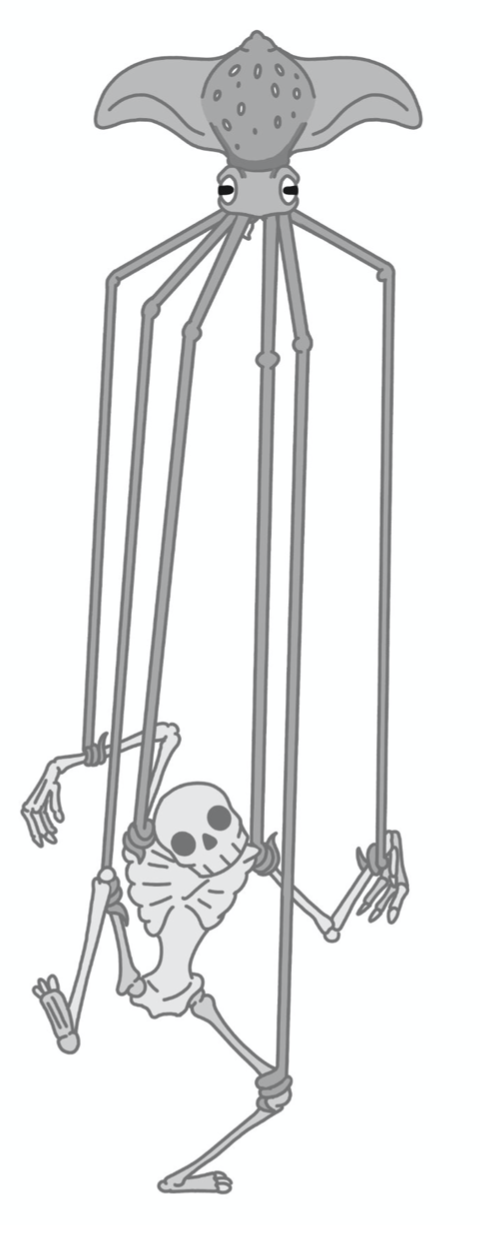
AROS eschews goblins, dragons and all the familiar beasties of bog-standard fantasy RPGs. In their place, AROS offers 42 new monsters to find in the Deep Queen’s Temple (the section, entitled “Creatures of the Deep” is curiously omitted from the table of contents, but this is just another nit). The monsters are statted for Knave but could be converted with a modicum of effort. Almost every monster also has one of the aforementioned Mutations. So if a character eats the Sand of a Dolpod (a dolphinesque humanoid), you have a 25% chance that your forehead expands to make room for resonating space you need in your sinuses and you gain the power of echolocation when you make loud clicking noises. My favorite mutations are of this variety, where the power is telegraphed by physical changes in the Heir. Gaining enough mutations may also impact what happens the Deep Queen is encountered (though for exactly how, you will need to play in or read the adventure for yourself!). There are plenty of excellent monsters listed in AROS to populate the repeated dungeon runs. One of my favorites is the Marionetta Squid, which has a gimmick that the picture alone easily communicates.


Using all new monsters is purposeful for the design of AROS. The monsters not only mesh with the adventure aesthetically—the monsters share an aquatic theme, and not in the lazy way of many D&D aquatic monsters (I have in mind Lacedons and Koalinths)—but also are integral to make repeated excursions into the dungeon a meaningful and engaging experience. When you fight a goblin in D&D, you probably already know what you are getting into. Even if goblins are new to your character, you as a player know their essential characteristics. But how much do you know about a chum? Could you, for instance, distinguish a balloon chum from a tropical chum? Unless you are a veteran of AROS, I suspect the answer is a definitive “no.” In AROS, the Heirs and the players themselves each learn more and more about the ecology of the Deep Queen’s Temple with each run. Because of the “Sand” in AROS, players are encouraged to metagame with this knowledge, as it represents something subsequent Heirs learn from their forebears.

Memory, Metagaming & Mastery

In AROS, when any creature, including a Heir, dies, they leave behind grains of sand, appropriately called “Sand.” When a Heir ingests the Sand, they gain some XP and the memories of that creature. This is how Heirs pass down memories from generation to generation. As AROS explains, “There aren’t any actual rules for this, at least not in the traditional sense. Essentially you can metagame with knowledge from previous runs.” I’m glad that AROS uses the term metagaming if only to allow me to talk about it briefly. 


Metagaming is bandied about as a pejorative term and it is unduly maligned in roleplaying games. Metagaming is an acknowledgement that there is a disconnect between the knowledge of the player and the knowledge of their character as well as a taboo against using exclusively player-knowledge in games. An example in the above-linked Papers & Pencils blog post is the player knowing the effect of fires on trolls while the character has not experienced a troll. The taboo arises in more thespian-oriented games and is verboten because it is an example of breaking character. In the Wikipedia article on the subject, it says that metagaming is “considered unsporting or cheating”, although this claim is both in passive voice (considered by whom?) and followed by a [citation needed]. 


While I agree with my colleague, Nick LS Whelan, on having no qualms with metagaming, AROS is intentionally designed to (1) encourage metagaming-like behavior and (2) justify metagaming such that player knowledge IS character knowledge, for the most part. Because there are no goblins or other recognizable trappings of fantasy RPGs, players and their Heirs start their first run through the dungeon with the same minimal set of knowledge. What is learned about the dungeon, from its contents to its denizens, is passed down from Heir to Heir. There is little that the player knows that their current Heir shouldn’t know equally well. However, while this is not metagaming from a definitional standpoint, it facilitates player-challenge-based play, which is a strength of metagaming. In TTRPGs, typically both the character and the player are being challenged in different ways. While the character may become better equipped to face their challenges through level-ups, finding items or other in-game processes of advancement, the player only has one avenue for advancement: becoming a better player. Mastery of the system, mastery of their character, mastery of the game, all of these improve over time. With repeated runs of the same (or similar, being generated by the same procedure) dungeon, the player gains knowledge that helps them improve at facing the challenges therein. Even outside of AROS, this is fun for some players and groups. What AROS does, and it is a great strength of the adventure, is that it bakes this type of player-challenge-based play into the adventure fictionally. It truly is not metagaming to use the player-knowledge from previous runs in a current or future run through the Deep Queen’s Temple because your Heir has the same knowledge, passed down from the Sand. This fictional conceit is a permission structure for players to embrace player-challenge and dungeon-mastery (of a different sort than is typically meant by “dungeon master”), free from any character-breaking that is considered (presumably, by someone) cheating. In AROS, it would be unsporting to not metagame (and, given AROS’ deadliness, self-sabotaging).


Press F for Action Prompts

While AROS ingeniously integrates its video game inspirations into TTRPG form when it comes to roguelites, there are small portions that feel video-gamey in a less-than-stellar way. This is not a problem unique to AROS; I’ve come across it so often that I have given it a name: the Action Prompt Problem. Action prompts are moments in those quick time events commonly used in video games. They allow a scintilla of player input during largely cinematic sequences, for instance, allowing the player to pay respects during a cutscene of a funeral by pressing a button. In TTRPGs, this impulse manifests itself in referee-facing cues that trigger based on player action that the player is unlikely to actually perform unprompted. Secret information is good, but players should have some reasonable inkling that the secret information is there or a reason to interact with the world in a way that might reveal it. I will go over one example of the Action Prompt Problem in action in AROS, along with a simple “fix” for it. Hopefully this example better illustrates what this problem is, why it is a problem and how to avoid it in writing site-based adventures. 


The weeping statue. In one of the rooms of the Kelp Forest, there is an alcove with a statue of a weeping man, among other things. The referee-facing room description says “If the Heirs wash their face in the tears of the male statue, they can see a path across the abyss [the major feature of the room]. It twists and undulates but provides solid footing.” My issue is simply why would the players wash their face? Investigate the crying statue, sure, but nothing about the statue or the room indicates that this is the time for a skincare routine. Contrast this with the other statue in the room, which the read-aloud text describes as “a statue of a woman holding a small bundle wrapped in seaweed up to her chest. She similarly has water running down her face, but it pools onto the floor and runs into the abyss.” This statue has hidden information (as opposed to secret information; for a taxonomy, check out this excellent post from DIY & Dragons), but it is gleaned simply by “investigating the bundle in the arms of the female statue,” an action thoughtful players are already likely to take. My fix to the face washing prompt is simple: get the players dirty. Either through an ink cloud of one of the creatures that emits it, or have another enemy fling mud at them. When the dirty PCs come to the room with the statues, they do not have a reason to know that either statue has magic face-washing properties, but they at least have a potential reason to want to wash their face. Another solution is just to tell the players, if they so inquire, that the water coming from the male statue looks different than the water from the female statue. But I like the dirty face idea more. Sometimes it is fun when players push a big red button by dumb luck.


Adventure Coherence

Despite a few pedantic nit picks (solely in an attempt to live up to my series’ name, I assure you), AROS is an unusually coherent adventure. That is not to say that other adventures are incoherent in the sense that they are incomprehensible; I mean to say that AROS coheres together to form a unified whole, while I approach other adventurers like a car mechanic in a junkyard, looking for parts to rip out and insert into whatever I’m currently building. I am not sure that there are any specific, discrete parts of AROS I would steal, because each part is so codependent on the rest. AROS is the rare sort of adventure that I would not only consider running, but that I would consider running by the book. Rarer still, AROS’ roguelite elements and its full embrace of the positives of metagaming result in it being an adventure that benefits from repeated games, even with the same group. TL;DR: I recommend AROS to any dungeon-master whose players would enjoy experiencing their own, distinct form of dungeon-mastery.

Where to Find A Rasp of Sand

A Rasp of Sand was written by Dave Cox. It can be obtained in PDF for $10 on itch.io or in softcover for $18 on DriveThruRPG


Folie à Trois: Trophy Gold

Below is a shared review of Trophy Gold (2022) , a fantasy adventure game designed by Jesse Ross and published by The Gauntlet. Although it...